Understanding fractions and decimals may be a breakthrough in your child’s advancement in math. The concepts are the foundation of more advanced mathematical abilities such as percentages, ratios and algebra in the future. However, in the case of the majority of children, fractions and decimals tend to look abstract or confusing. You, as a parent, can bring these points to life with the help of a certain creativity and real-life examples. You need a couple of simple tips on math and your child can master fractions and decimals without much effort.
1. Start with the Basics: What Are Fractions and Decimals?
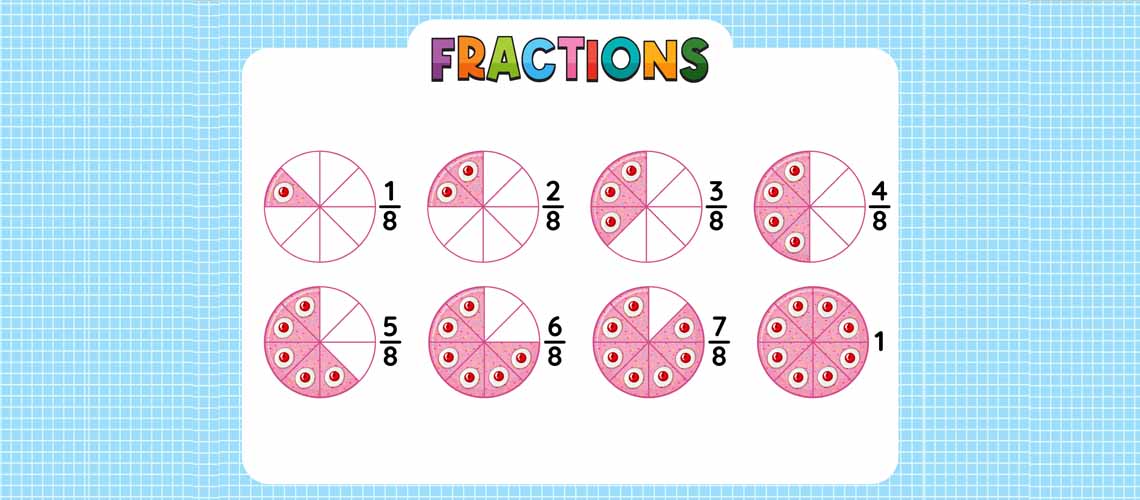
A fraction represents a part of a whole – like half a pizza or one-fourth of a chocolate bar. It is written in the form of numerator/denominator where the numerator would indicate the number of parts you possess and the denominator the number of parts overall.
Example: If a pizza is cut into 8 equal slices and your child eats 3, the fraction is 3/8.
A decimal, on the other hand, is another way of representing fractions, but using a dot (.) instead of a line. For example, 1/2 = 0.5 and 1/4 = 0.25.
2. Fun Fraction Activity: Learning Through Pizza or Chocolate!
A real-life activity is one of the most effective methods of teaching fractions at home. Make an attempt to play such easy, interesting game:
Pizza Fraction Activity:
- Cut a pizza (or use a paper circle) into equal slices.
- Ask your child to identify how many parts the pizza has – that’s the denominator.
- Then, remove a few slices and count what’s left? That’s the numerator.
- Now ask, “What fraction of the pizza did we eat?”
This hands-on approach helps kids see fractions rather than just imagine them.
3. Tricks for Addition and Subtraction of Fractions
In addition to and subtraction, many students have difficulties with adding and subtracting fractions – primarily due to the various denominators. It can be simply described in the following manner:
Trick:
To add or subtract fractions:
- Find a common denominator.
- Convert both fractions so that the denominators match.
- Add or subtract the numerators and keep the denominator same.
Example: 1/2 + 1/3 → Common denominator = 6 → Convert: (3/6 + 2/6) = 5/6.
4. Fraction to Decimal Conversion Made Easy
Finding out how to convert a fraction to a decimal is not an easy task but here is an easy method your child can memorize:
Trick:
Just divide the numerator by the denominator!
Example: 1/2 = 1 ÷ 2 = 0.5 and 3/4 = 3 ÷ 4 = 0.75.
5. Decimal to Fraction Conversion: The Reverse Trick!
Here’s how to explain converting decimals back into fractions – in three easy steps:
- Count the digits after the decimal point.
- Write the number without the decimal as the numerator.
- Use 10, 100, 1000, etc. as the denominator (based on decimal places).
- Simplify the fraction if possible.
Example: 0.25 → 25/100 → Simplify → 1/4; 0.5 → 5/10 → Simplify → 1/2.
6. How to Compare Fractions — The Butterfly Trick
When kids see two fractions like 3/4 and 2/3, they often get stuck deciding which is bigger. Here’s a quick visual trick that always works:
The Butterfly Trick:
- Multiply the numerator of one fraction by the denominator of the other.
- Do the same for the other fraction.
- The larger product shows the greater fraction.
Example: To compare 3/4 and 2/3, → 3 × 3 = 9 → 2 × 4 = 8 → So, 3/4 is greater than 2/3.
7. Converting Fractions and Decimals to Percentages
Percentages are simply fractions and decimals written in a different form – “out of 100.”
Trick 1:
Fraction to Percentage → Multiply the fraction by 100.
Example: 3/4 × 100 = 75%.
Trick 2:
Decimal to Percentage → Multiply the decimal by 100 and add the % sign.
Example: 0.5 × 100 = 50%.
8. Fraction Simplification Tricks
Fraction simplification may appear very daunting but it is simply a question of identifying a common denominator that will divide both the numerator and denominator.
Trick:
Divide the numerator and denominator by the greatest common divisor (GCD).
Example: 6/12 → Divide both by 6 → 1/2.
9. Everyday Practice Ideas for Parents
- Use cooking and recipes: Ask your child to measure “half a cup” or “one-fourth spoon” of ingredients.
- Play with coins: Teach decimals by using rupees and paise (₹1.50 = ₹1 and 50 paise).
- Create a ‘Fraction of the Day’ board: Stick one fraction each day and ask your child to show its decimal and percentage equivalents.
- Turn mistakes into learning: Encourage guessing, even if it’s wrong, guide them to correct it. That’s how true understanding develops!
10. Why Fractions and Decimals Matter in the Long Run
Fractions and decimals don’t just help in math – they’re life skills! From dividing food to managing money, from recipes to measurements, your child will use them every day. Learning these early, with real-world connections, builds a strong mathematical foundation.
Conclusion: Building Math Confidence with EuroSchool
At EuroSchool, we believe that learning math should be a fun and experiential process. Our teaching method aims at practical learning, visual learning, and conceptual learning as opposed to rote learning. Children not only learn such concepts as fractions and decimals but also learn to love learning through the use of engaging activities and personalised attention.
Make your child have confidence in math by enrolling him or her in EuroSchool scientifically developed curriculum and fun all-learning atmosphere.
Visit EuroSchool today to explore how we make learning math exciting and meaningful for your child!