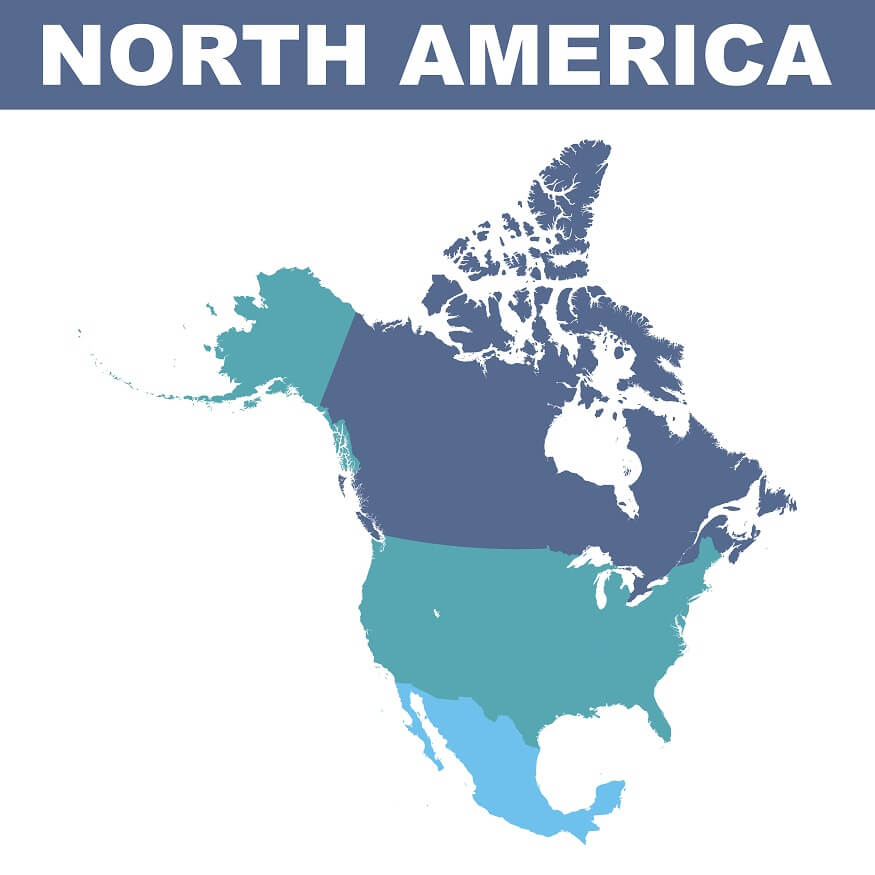
North America is one of the most fascinating continents in the world. Located entirely in the Northern Hemisphere and largely in the Western Hemisphere, it is surrounded by the Arctic Ocean in the north, the Atlantic Ocean in the east, the Pacific Ocean in the west, and the Caribbean Sea and South America to the south.
From icy tundras and vast deserts to busy cities and rich wildlife, North America offers endless geographical variety. Learning about this continent helps children understand different landforms, cultures, climates, and ecosystems in an engaging way. Below are 20 fun and interesting facts about North America that children will enjoy discovering.
Fun Facts About North America
1. Third Largest Continent
North America is the third-largest continent in the world, after Asia and Africa. It covers about 24.7 million square kilometres, which is nearly 16.5% of Earth’s total land area.
2. Fourth Most Populated
It is the fourth most populated continent, after Asia, Africa, and Europe.
3. Number of Countries
North America consists of 23 independent countries. The largest by area are Canada, the United States, and Mexico, while some of the smallest include Saint Kitts and Nevis.
4. Home to the Great Lakes
The Great Lakes: Lake Superior, Lake Michigan, Lake Huron, Lake Erie, and Lake Ontario form the largest group of freshwater lakes in the world, holding around 21% of the planet’s surface freshwater.
5. Largest Freshwater Lake
Lake Superior is the largest freshwater lake in the world by surface area.
6. Longest River
The Missouri River is the longest one in North America, stretching approximately 3,767 kilometres.
7. The Grand Canyon
The Grand Canyon in the United States is one of the world’s most famous natural wonders. It is about 446 kilometres long and over 1.6 kilometres deep.
8. Highest Mountain Peak
The tallest mountain in North America is Denali (formerly Mount McKinley) in Alaska, standing 6,190 metres above sea level.
9. Death Valley Extremes
Death Valley, located in the United States, is one of the hottest, driest, and lowest places on Earth. Its lowest point, Badwater Basin, lies 86 metres below sea level.
10. Greenland
Greenland, the world’s largest island, lies in North America and is governed by Denmark.
11. Northern Lights
The Aurora Borealis, or Northern Lights, can be seen in places like Alaska and northern Canada, lighting up the sky in shades of green, pink, red, and yellow.
12. Rich Wildlife
North America is home to diverse wildlife such as bears, moose, bison, wolves, and bald eagles, along with a wide range of marine life.
13. Oldest National Park
Yellowstone National Park in the United States is the world’s first national park, established in 1872.
14. Famous Cities
Major cities such as New York, Los Angeles, and Chicago (USA), Toronto and Vancouver (Canada), and Mexico City (Mexico) are located in North America.
15. Statue of Liberty
The Statue of Liberty, gifted by France to the United States in 1886, symbolises freedom and democracy.
Also Read: Exploring Global Geographical Features and Famous Landmarks
16. Hollywood
Hollywood, located in Los Angeles, is known as the movie capital of the world and plays a major role in global entertainment.
17. Diverse Ecosystems
The continent features a wide range of ecosystems, from Arctic tundra in northern Canada to rainforests, grasslands, deserts, and mountain ranges.
18. Famous Bridges
North America is home to iconic bridges such as the Golden Gate Bridge, Brooklyn Bridge, and Verrazzano-Narrows Bridge, one of the world’s largest suspension bridges.
19. Languages Spoken
The most commonly spoken languages in North America are English, Spanish, and French.
20. Famous Waterfalls
Niagara Falls, located between the United States and Canada, is one of the most powerful and well-known waterfalls in the world.
Also Read: What is Sundial? Know What It Means, History, Types, And Interesting Facts
Why Learning Geography Is Important for Children
Understanding continents like North America helps children develop awareness of the world around them. Geography encourages curiosity, strengthens critical thinking, and builds connections between nature, people, and cultures.
At EuroSchool, known among the best schools in Yelahanka that study focused and interactive learning approaches, geography is taught using engaging methods that help students explore the planet meaningfully. Through maps, discussions, visuals, and real world examples, students build a strong understanding of global geography while developing problem solving and analytical skills.
Conclusion
North America is a continent full of natural wonders, cultural diversity, and exciting facts that capture children’s imagination. Learning about its geography not only builds knowledge but also encourages respect for nature and global cultures.
By making geography interesting and accessible, EuroSchool ensures that students gain both academic understanding and a lifelong curiosity about the world.