
Physics isn’t locked inside textbooks or complicated equations-it’s happening around you every single moment. From the second your alarm wakes you up to the moment you switch off the lights at night, physics is quietly running the show.
Whether you’re walking, writing, scrolling on your phone, enjoying cool air from a fan, or travelling in a car, physics is at work. It helps us understand why things move, why they stop, how energy flows, and how technology makes life easier.
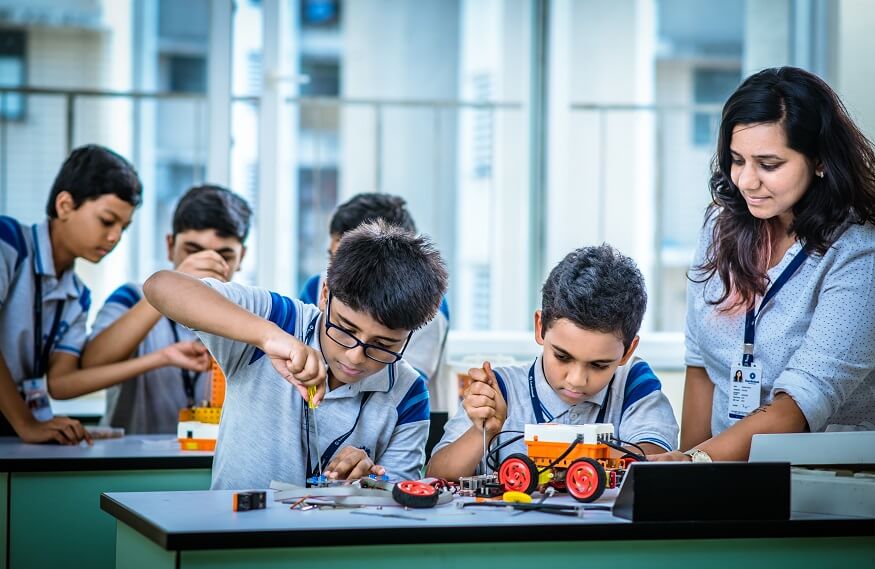
At EuroSchool, students across ICSE and CBSE schools experience physics not just as a subject, but as a real-world story-one they can see, touch, and experiment with every day.
Let’s explore 10 simple and fascinating examples of physics in daily life that prove learning physics can actually be fun.
1. Walking and Running – The Magic of Friction
Ever wondered why you don’t slip every time you take a step?
That’s friction at work. Friction creates a gripping force between your shoes and the ground, allowing you to move forward safely.
- Rough surfaces like carpets create more friction, making walking easier
- Smooth surfaces like ice create less friction, making slipping more likely
Without friction, walking or running would be impossible-we’d all be sliding around like penguins!
2. Alarm Clock – Sound and Energy in Action
That annoying ring-ring in the morning? Pure physics.
An alarm clock converts stored energy into sound energy. In mechanical clocks, energy stored in a spring turns into motion and then into sound waves that travel through air to reach your ears.
You may hate waking up-but physics makes sure you do
3. Ballpoint Pen – Tiny Physics, Big Impact
A ballpoint pen is a brilliant example of fluid dynamics and friction.
- A tiny metal ball rotates as you write
- Ink flows from the refill to the paper
- Gravity and pressure ensure smooth writing
Simple design. Smart physics.
4. Roller Coasters – Thrill Powered by Physics
Roller coasters perfectly combine gravity, energy, and motion.
- The climb stores potential energy
- The drop converts it into kinetic energy
- Loops and turns involve centripetal force and acceleration
The result? Heart-racing fun-controlled by physics to keep riders safe.
5. Ceiling Fans – Cooling Through Airflow
Fans don’t cool air-they move it.
Rotating blades create low pressure behind them, pulling air forward. This airflow speeds up sweat evaporation, making you feel cooler.
Fluid dynamics + electromagnetism = summer survival 🌬️
6. Refrigerators – Keeping Things Cool
Refrigerators work on thermodynamics.
They:
- Remove heat from inside
- Release it outside
- Use compression and expansion of refrigerants
That’s how your food stays fresh-even in peak summer.
Also Read: Physics Fun: Gravity, Motion, and Simple Machines
7. Mobile Phones – Physics in Your Pocket
Every tap and swipe on your phone involves physics:
- Touchscreens detect electrical charge changes
- Calls and data travel as electromagnetic waves
- Batteries rely on electron flow
Your smartphone is basically a mini physics lab
8. Aeroplanes – Defying Gravity (Safely!)
Aeroplanes fly because of aerodynamics.
- Air moves faster above the wings than below
- Pressure differences create lift
- Newton’s laws and Bernoulli’s principle keep planes airborne
Flying isn’t magic-it’s physics at 30,000 feet
9. Batteries – Powering Everyday Life
Batteries store chemical energy and convert it into electrical energy.
When electrons flow through a circuit, your devices turn on. From toys to laptops, batteries prove how physics powers modern life.
10. Automobiles – Physics on the Road
Cars combine multiple physics concepts:
- Engines use thermodynamics
- Brakes rely on friction
- Motion follows Newton’s laws
- Shape affects aerodynamics
Every journey is a lesson in applied physics
Why Learning Physics Through Daily Life Matters
Physics helps students:
- Understand how the world works
- Think logically and solve problems
- Connect classroom concepts to real experiences
- Build curiosity and innovation
At CBSE schools in Whitefield, physics is taught through visuals, experiments, real-life demonstrations, and hands-on activities, ensuring students never ask, “Why do we need to learn this?”
Final Thoughts
Physics isn’t just a subject-it’s the language of the universe. Once students begin to notice physics in everyday life, learning becomes natural, exciting, and meaningful.
At EuroSchool, we believe that when students see physics in action, they don’t just learn it-they remember it for life.