
Choosing the right education board is one of the most important decisions parents make for their children. In India, the Central Board of Secondary Education, commonly known as CBSE, remains the most widely recognised and preferred board for school education. Whether you are a parent researching options for your child or a student trying to understand what CBSE offers, this guide covers everything you need to know about the CBSE board, its curriculum, exam structure, grading system, and benefits.
What Is the CBSE Board?
CBSE stands for the Central Board of Secondary Education. It is a national-level board of education in India, operating under the Union Government. Established in 1962, CBSE is responsible for conducting examinations and setting the academic framework for affiliated schools across India and abroad. Over 28,000 schools in India and more than 240 schools in foreign countries are affiliated with the CBSE board, making it one of the largest education boards in the world.
CBSE is headquartered in New Delhi and plays a crucial role in shaping the educational landscape of the country. The board prescribes the curriculum, designs textbooks through NCERT (National Council of Educational Research and Training), and conducts the Class 10 and Class 12 board examinations every year.
CBSE Curriculum and Syllabus
The CBSE curriculum follows the National Curriculum Framework (NCF) and relies on NCERT textbooks as the primary learning resource. The syllabus is designed to provide a strong foundation in core subjects such as Mathematics, Science, Social Science, English, and Hindi. It also offers a wide range of elective subjects at the senior secondary level, including Computer Science, Economics, Psychology, Physical Education, and Fine Arts.
One of the key strengths of the CBSE curriculum is its balanced approach. It combines academic rigour with skill-based learning, encouraging students to think critically and apply knowledge in real-world situations. The board has also integrated competency-based questions and case studies into its assessment pattern, which helps students develop analytical thinking from an early stage.
CBSE Exam Pattern and Assessment
CBSE conducts board examinations for Class 10 and Class 12 students every year, typically between February and March. The assessment pattern includes both internal assessments and external board exams. For most subjects, the board exam carries 80 marks and internal assessment accounts for 20 marks.
The question papers are structured to test different cognitive levels. Students can expect a mix of objective-type questions, short-answer questions, long-answer questions, and competency-based questions. This varied format ensures that students are not only tested on memory recall but also on their ability to reason, analyse, and apply concepts.
CBSE also conducts periodic assessments, project work, and practicals as part of its Continuous and Comprehensive Evaluation (CCE) framework. This approach allows for a more holistic understanding of a student’s progress throughout the academic year.
CBSE Grading System
CBSE uses a grading system that assigns grades based on the marks obtained by students. For Class 10, grades range from A1 (91 to 100) to E (below 33). Each grade corresponds to a grade point, which helps in calculating the Cumulative Grade Point Average (CGPA). For Class 12, marks are reported directly along with grades. The grading system is designed to reduce undue pressure on students by shifting the focus away from exact numerical scores and toward broader performance bands.
Benefits of Studying Under the CBSE Board
There are several reasons why CBSE continues to be the preferred board for millions of families across India. First, the CBSE curriculum is aligned with major competitive examinations such as JEE (Joint Entrance Examination) and NEET (National Eligibility cum Entrance Test). This gives CBSE students a significant advantage when preparing for engineering and medical entrance exams, as the syllabus overlaps considerably.
Second, CBSE offers a standardised curriculum across the country. Whether a student is studying in Delhi, Mumbai, or a smaller city, the syllabus, textbooks, and exam pattern remain consistent. This is particularly helpful for families who relocate frequently due to professional reasons, as children can transition between CBSE schools without any disruption in their learning.
Third, CBSE places strong emphasis on co-curricular activities, sports, and overall personality development. The board encourages schools to go beyond textbook learning and offer programmes that nurture creativity, leadership, and physical fitness. Fourth, the availability of NCERT textbooks at affordable prices makes quality education accessible to a wider population. These books are written in clear, simple language and are considered among the best study resources for foundational learning.
CBSE Recognition and Acceptance
CBSE is recognised by the Government of India and is accepted by all universities and educational institutions across the country. Students who complete their education under the CBSE board can apply to colleges and universities in India and abroad without any issues. The board’s credibility and widespread acceptance make it a safe and reliable choice for long-term academic planning.
CBSE and the National Education Policy (NEP) 2020
CBSE has been actively implementing the recommendations of the National Education Policy (NEP) 2020. The board has introduced changes such as a focus on experiential learning, reduced syllabus load, and greater flexibility in subject selection. Students now have the option to choose subjects across streams, which was not possible earlier. For example, a student can study both Physics and Economics together without being restricted to a single stream.
The NEP also emphasises multilingual education, coding and computational thinking at the school level, and a shift toward formative assessments rather than high-stakes exams. CBSE has already started rolling out many of these changes, making the board more progressive and student-friendly than ever before.
How to Choose the Right CBSE School
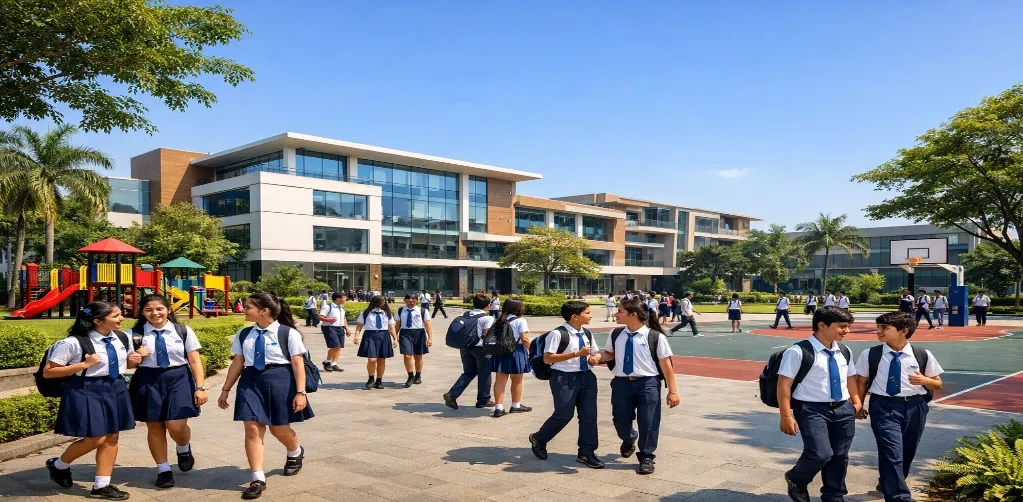
When selecting a CBSE school for your child, it is important to consider factors beyond just the board affiliation. Look for schools that offer a well-rounded education, including strong academics, sports facilities, technology-enabled classrooms, and a supportive learning environment. Check whether the school has experienced and trained faculty, a good track record in board results, and a focus on overall student development rather than just marks.
Conclusion
The CBSE board continues to be a top choice for students and parents across India, thanks to its comprehensive curriculum, alignment with competitive exams, standardised approach, and progressive reforms under the NEP 2020. It provides a strong academic foundation while also encouraging holistic development, making it an ideal choice for students who want to succeed both in academics and in life.
If you are looking for a school that combines the strength of the CBSE curriculum with world-class infrastructure and a focus on all-round development, EuroSchool is an excellent option. With CBSE-affiliated campuses across major cities in India, EuroSchool offers a learning environment that goes beyond textbooks to prepare students for the challenges and opportunities of the future. To learn more about admissions and campus locations, visit euroschoolindia.com.