We use the names of the days of the week every single day, but how often do we stop to think about where those names actually come from? The seven days of the week have fascinating origins rooted in ancient astronomy, Roman gods, and Norse mythology. In this post, we will explore the meaning behind each day’s name, the history of the seven-day week, and much more.
A Brief History of the Seven-Day Week
The concept of a seven-day week dates back thousands of years. The ancient Babylonians are credited with establishing the seven-day cycle, which they based on the seven celestial bodies visible to the naked eye: the Sun, the Moon, Mars, Mercury, Jupiter, Venus, and Saturn. Each day was dedicated to one of these heavenly bodies.
The Romans adopted this system and named the days after their corresponding gods and planets. Later, as Germanic and Norse cultures spread across Europe, several of the Roman names were replaced with their Norse equivalents. The English names we use today are a blend of Roman and Norse influences.
All 7 Days of the Week: Names, Order, and Origins
1. Sunday
Sunday is the first day of the week in many cultures, including in the United States and India. Its name comes from the Old English “Sunnandæg,” which means “day of the Sun.” The Romans called it “dies Solis,” also meaning the day of the Sun. Sunday was historically dedicated to the worship of the Sun, which was considered a powerful celestial body in many ancient cultures.
2. Monday
Monday is named after the Moon. It comes from the Old English “Monandæg,” meaning “day of the Moon.” The Roman name for this day was “dies Lunae,” which also translates to the day of the Moon. This connection to the Moon is still visible in many other languages. For example, Monday is called “Lundi” in French and “Lunes” in Spanish, both derived from the Latin word “Luna.”
3. Tuesday
Tuesday is named after Tiw (also spelled Tyr), the Norse god of war and justice. The Old English name was “Tiwesdæg,” meaning “day of Tiw.” This replaced the Roman name “dies Martis,” which was the day of Mars, the Roman god of war. Both Tiw and Mars served similar roles in their respective mythologies, which is why the substitution was made.
4. Wednesday
Wednesday is named after Woden (also known as Odin), the chief god in Norse mythology. The Old English name was “Wodnesdæg,” meaning “day of Woden.” It replaced the Roman “dies Mercurii,” the day of Mercury. Woden and Mercury were both associated with wisdom, travel, and communication, which made them natural counterparts. The silent “d” in Wednesday is a remnant of the original pronunciation tied to Woden’s name.
5. Thursday
Thursday is named after Thor, the Norse god of thunder, strength, and storms. The Old English name was “Þunresdæg,” meaning “day of Thunder” or “day of Thor.” It replaced the Roman “dies Iovis,” the day of Jupiter. Jupiter, like Thor, was a sky god associated with thunder and lightning. The connection between Thor and Thursday is easy to hear when you say the name aloud.
6. Friday
Friday is named after Frigg (or Freya), the Norse goddess of love, beauty, and fertility. The Old English name was “Frigedæg,” meaning “day of Frigg.” It replaced the Roman “dies Veneris,” the day of Venus, the Roman goddess of love. Both Frigg and Venus represented love and beauty, which is why the Norse name was a natural replacement. In many Romance languages, the connection to Venus remains clear. For example, Friday is “Vendredi” in French and “Viernes” in Spanish.
7. Saturday
Saturday is the only day of the week in English that retains its Roman name. It is named after Saturn, the Roman god of agriculture, wealth, and time. The name comes from the Old English “Sæternesdæg,” meaning “day of Saturn.” The Romans called it “dies Saturni.” Unlike the other days, the Norse cultures did not replace Saturn’s name with a Norse equivalent, so the original Roman influence has survived in English.
Quick Reference: Days of the Week in Order
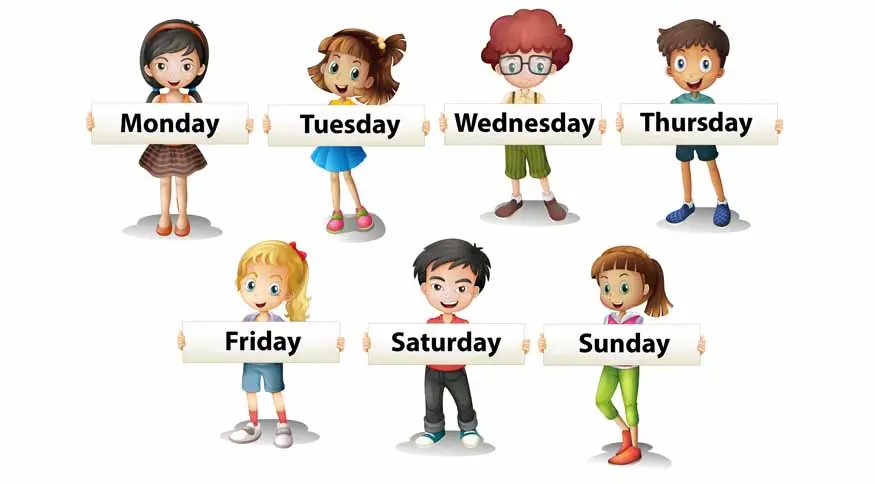
Sunday: Day of the Sun Monday: Day of the Moon Tuesday: Day of Tiw (Norse god of war) Wednesday: Day of Woden/Odin (Norse chief god) Thursday: Day of Thor (Norse god of thunder) Friday: Day of Frigg/Freya (Norse goddess of love) Saturday: Day of Saturn (Roman god of agriculture)
Does the Week Start on Sunday or Monday?
This depends on cultural and regional conventions. In many countries, including the United States, Canada, India, and Japan, the week traditionally starts on Sunday. However, in most European countries, Australia, and many parts of South America, the week begins on Monday. The International Organization for Standardization (ISO 8601) designates Monday as the first day of the week.
The Planetary Connection
The seven days of the week were originally linked to the seven classical planets, which were the celestial bodies visible without a telescope. Here is how each day connects to its planet:
Sunday: Sun Monday: Moon Tuesday: Mars (replaced by Tiw in English) Wednesday: Mercury (replaced by Woden in English) Thursday: Jupiter (replaced by Thor in English) Friday: Venus (replaced by Frigg in English) Saturday: Saturn
This planetary connection is still very visible in Romance languages like French, Spanish, and Italian, where the day names closely follow the Latin originals.
Number of Days in a Week and Related Facts
A standard week has 7 days. A year has approximately 52 weeks and 1 extra day (or 2 extra days in a leap year). A common year of 365 days contains exactly 52 weeks and 1 day. A leap year of 366 days contains exactly 52 weeks and 2 days. This is why the same date falls on a different day of the week each year. For example, if your birthday is on a Wednesday this year, it will most likely fall on a Thursday next year (or a Friday if a leap day occurs in between).
Why Do We Have 7 Days in a Week?
The choice of seven days is not based on any natural astronomical cycle that fits perfectly. A month roughly follows the Moon’s phases (about 29.5 days), and a year follows the Earth’s orbit around the Sun (about 365.25 days), but there is no celestial event that lasts exactly seven days.
The seven-day week likely originated from the Babylonians, who observed seven prominent celestial bodies and assigned one to each day. The number seven also held deep spiritual and symbolic significance in many ancient cultures. The concept was later adopted by the Jews, Greeks, Romans, and eventually spread across the world.
FAQs About Days of the Week
Q1: Why are the days of the week named after gods and planets?
The ancient Romans named each day of the week after the seven known celestial bodies, which were in turn associated with Roman gods. When Germanic and Norse peoples adopted the seven-day week, they replaced several Roman god names with their own equivalent Norse gods. English, being a Germanic language, inherited these Norse-influenced names.
Q2: Why is Saturday the only day with a Roman name in English?
The Norse cultures replaced most of the Roman day names with their own gods, but they did not have a direct equivalent for Saturn. As a result, Saturday kept its Roman origin while the other days were renamed after Norse deities.
Q3: What is the first day of the week?
It depends on where you are. In the United States, India, and several other countries, Sunday is considered the first day. In most of Europe and in the ISO 8601 international standard, Monday is the first day of the week.
Q4: Why is Wednesday spelled with a silent “d”?
The “d” in Wednesday comes from “Woden,” the Old English name for the Norse god Odin. Over centuries, the pronunciation shifted, and the “d” became silent, but the original spelling was preserved.
Q5: Do all languages name the days after gods?
No. While many European languages use names based on Roman or Norse gods, other languages take a completely different approach. For example, in Portuguese, most days of the week are simply numbered (segunda-feira for Monday means “second fair/day”). In Chinese, the days are also numbered, with Sunday being an exception. In Arabic, the days are named with meanings like “the first,” “the second,” and so on.
Q6: Is there a trick to remember the order of the days?
A simple way is to remember this sentence: “Silly Monkeys Try Whistling Tunes From Saturn.” The first letter of each word matches the first letter of each day: Sunday, Monday, Tuesday, Wednesday, Thursday, Friday, Saturday.
Q7: Has the seven-day week always been the standard?
Not everywhere. Various cultures have experimented with different week lengths. The ancient Egyptians used a 10-day week. The French Revolutionary Calendar, introduced in 1793, also used a 10-day week. The Soviet Union tried five-day and six-day weeks in the 1920s and 1930s. However, the seven-day week has proven to be the most enduring and is now used worldwide.
Q8: Why is Friday considered special in many cultures?
Friday holds significance across several traditions. In Christianity, Good Friday marks the crucifixion of Jesus. In Islam, Friday (Jumu’ah) is the day of congregational prayer. In popular Western culture, Friday is celebrated as the last workday before the weekend. The phrase “Thank God It’s Friday” (TGIF) reflects the widespread relief and joy people feel at the end of the work week.
Q9: How are weekdays and weekends defined?
In most Western countries, Monday through Friday are considered weekdays, and Saturday and Sunday form the weekend. However, this varies by country. In many Middle Eastern countries, the weekend falls on Friday and Saturday, with Sunday being a regular workday.
Q10: Will the seven-day week ever change?
It is extremely unlikely. The seven-day week has been in continuous use for thousands of years and is deeply integrated into global culture, religion, commerce, and law. Changing it would require an almost impossible level of worldwide coordination and agreement.