Have you ever wondered what are the odds of your child getting their favourite dessert today, or is it possible that it will rain tomorrow? That is precisely what probability helps us to comprehend, it’s all about the possibility of something happening! Education about probability is among the most entertaining methods of introducing children to the notion of early maths since it is something that children can actually witness and practise in their day-to-day lives. From playing board games to the weather forecast, probability is all around us. Then, it is time to immerse yourself in this interesting field of dice throws, card draws and some silly guesses, and make your child begin to think like a small mathematician.
1. What Is Probability?
Probability simply refers to the likelihood of an occurrence. An example is when you flip a coin; then there is the possibility that the coin will come up heads, fifty-fifty. The result of rolling a dice is that one in six is the likelihood of displaying the number four. Probability helps us make sense of uncertain occurrences by making predictions that are likely to happen in a rational manner.
The fundamental probability equation is:
Probability = (Number of favourable outcomes) ÷ (Total number of outcomes)
2. Why Teach Probability to Kids?
Teaching probability makes children think logically and make better decisions. It makes them think, be just and remain curious besides polishing their everyday maths. Children who also venture into probability start to learn how chance functions in real life, which makes them feel more confident to go about problems or make predictions. It develops logic and judgment skills, educates fairness and makes mathematics much more realistic, recognisable and fun.
3. Common Examples of Probability in Daily Life
We encounter probability all the time, even without realising it. Here are a few simple examples children can relate to:
Activity | Possible Outcomes | Example |
Flipping a coin | Heads or Tails | 50% chance of heads |
Rolling a dice | 1–6 | 1 in 6 chance of any number |
Drawing a card | Hearts, Diamonds, Clubs, Spades | 1 in 4 chance of hearts |
Weather forecast | Sunny or Rainy | 70% chance of rain |
Choosing crayons | Multiple colours | 1 in total crayons |
4. Rolling Dice: A Fun Way to Learn Probability
Dice are very useful in learning about probability since each roll presents an impartial and random outcome. There are six sides on a dice, numbered one to six.
For example:
- The chance of rolling a 3 is 1/6.
- The chance of rolling an even number (2, 4, or 6) is 3/6, which simplifies to 1/2.
Game to Try: Predict the Roll
Ask your child to make a guess before rolling the dice as to which number will come up. Roll the dice five times, and count the number of times that number appears. This is a playful exercise that will develop logical thinking, observation, and pattern recognition.
5. Drawing Cards: Probability with a Deck
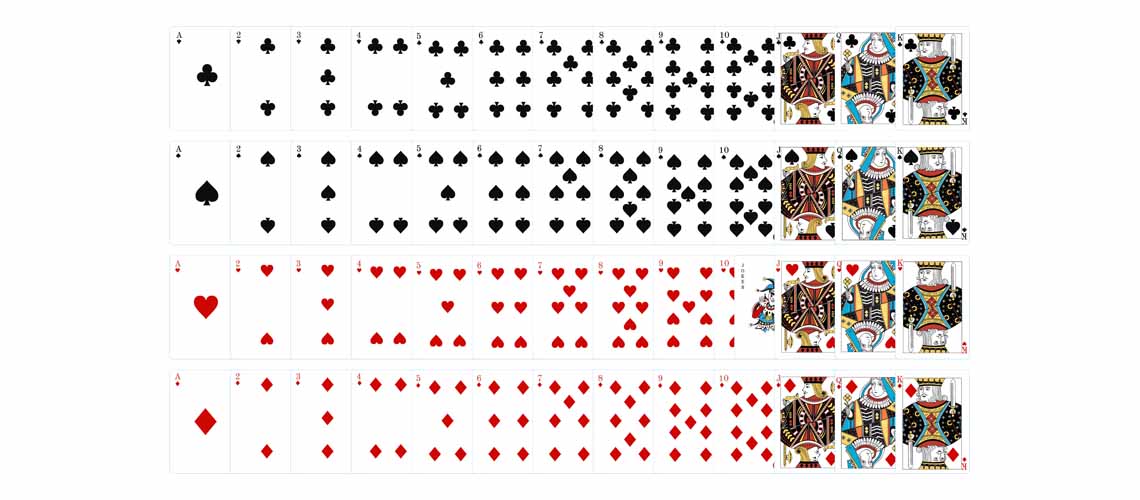
A deck of cards is another brilliant way to explore probability. It contains 52 cards, divided into four suits — Hearts, Diamonds, Clubs, and Spades — with 13 cards in each suit.
- The likelihood of getting a Heart is 13/52 = 1/4.
- The chance of getting a Red Card is 26/52 = 1/2.
- The chances of getting an Ace are 4/52 = 1/13.
Children have a chance to practise prediction on the kind of card they may draw and how frequently each type will appear, to determine how close reality will be to what they predict.
6. Probability Words Kids Should Know
It’s helpful to introduce a few key words that describe different likelihoods.
Word | Meaning | Example |
Certain | Will definitely happen | The sun rises every morning. |
Likely | Probably will happen | It might rain today. |
Unlikely | Might not happen | Snow in summer. |
Impossible | Can never happen | A fish driving a car! |
Equal chance | Both outcomes are the same | Heads or tails in a coin toss. |
7. Fun Probability Games for Kids
Turning probability into play makes it truly memorable. Try some of these:
- Dice Duel: Choose a number (one to six) and roll the dice ten times and see how many times the number comes up.
- Card Colour Challenge: Guess whether the card that is going to be drawn will be red or black.
- Colour Cube Mystery: Take coloured cubes in a bag, draw them out one at a time, and make a note of the colours that are most frequently drawn.
- Spinner Surprise: Prepare a coloured paper spinner, spin it and see which colour is on the top the most.
All these games teach children to observe, record and analyse outcomes in the process of having fun.
8. Learning Through Play: The Secret to Math Success
Children learn mathematics best when they consider it as a game. When the lessons are interactive, children get more curious and confident. Play-based learning enhances reasoning and experimental skills, and transforms abstract mathematical concepts into something concrete and entertaining. The strategy also creates a favourable feeling towards maths at an early age, and children can feel that numbers are something to find out about and not be afraid of.
9. Simple Probability Experiments
Here are a few simple activities to try at home:
- Coin Toss: Flip a coin twenty times and record the number of times it comes up heads or tails.
- Marble Jar: Prepare a jar of marbles of various colours, draw them one at a time and note down the findings.
- Weather Watch: Monitor the weather every single day for a week, then predict the weather for the following day.
These practical experiments provide children with hands-on experience in the field of data collection and probability in real life.
10. How EuroSchool Encourages Early Math Learning
We at EuroSchool believe that maths taught through play, observation and real-life examples is the best way of teaching children. Learning about probability becomes interesting and easy to comprehend through our interactive maths lessons and our approach to teaching probability. We also include the use of dice and card games, colour-coded puzzles, story-based challenges and practical tasks to build good number sense and logical reasoning.
By learning probability in a fun and creative way, children begin to understand patterns, fairness, and how outcomes are formed. Through these enjoyable games and activities, maths becomes an adventure rather than a chore.
Visit EuroSchool to discover how our play-based learning programmes make early maths engaging, logical, and full of fun discoveries!