
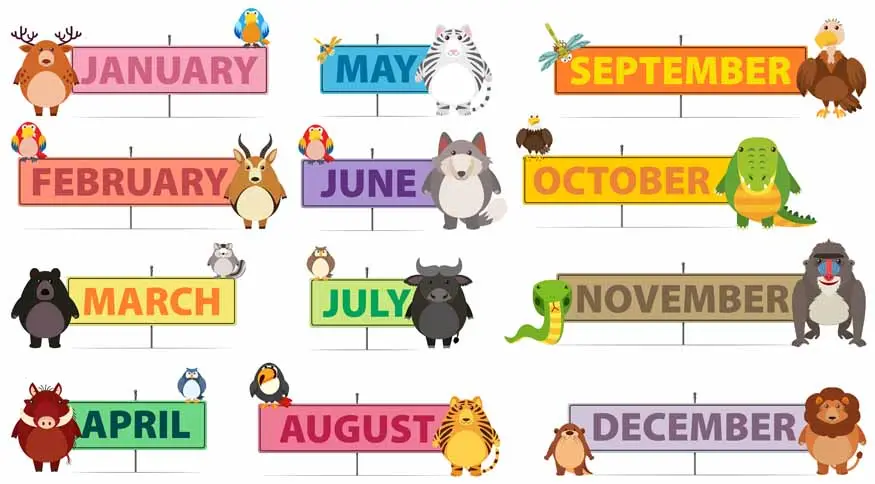
Have you ever wondered why January is called January or how February got its name? The names of the months we use today carry thousands of years of history, stretching back to ancient Rome. In this post, we will explore where each month name comes from, how many days each month has, and how leap years work.
A Brief History of the Calendar
The modern calendar, known as the Gregorian calendar, was introduced by Pope Gregory XIII in 1582. It replaced the older Julian calendar, which had been in use since 45 BCE under Julius Caesar. Before that, the Roman calendar originally had only 10 months, starting with March. January and February were added later by King Numa Pompilius around 713 BCE.
All 12 Month Names, Their Origins, and Number of Days
1. January (31 Days)
January is named after Janus, the Roman god of beginnings, transitions, and doorways. Janus is often depicted with two faces, one looking forward and one looking back. This makes January a fitting start to the year, as it represents looking back at the past and forward to the future.
2. February (28 Days / 29 Days in a Leap Year)
February takes its name from the Latin word “februum,” which means purification. The Romans held a purification festival called Februa during this month. February is the shortest month of the year, with 28 days in a common year and 29 days in a leap year.
3. March (31 Days)
March is named after Mars, the Roman god of war. In the original Roman calendar, March was the first month of the year because it marked the beginning of the military campaign season after winter. Even today, March signals the transition from winter to spring in the Northern Hemisphere.
4. April (30 Days)
The origin of April’s name is debated. Some scholars believe it comes from the Latin word “aperire,” meaning “to open,” referring to the opening of flowers and buds in spring. Others connect it to Aphrodite, the Greek goddess of love. April has 30 days.
5. May (31 Days)
May is named after Maia, a Roman goddess associated with growth and fertility. Maia was also the mother of the god Mercury in Roman mythology. May has 31 days and is widely associated with the full bloom of spring.
6. June (30 Days)
June is named after Juno, the Roman goddess of marriage and the queen of the gods. Because of this connection to marriage, June has long been considered a popular month for weddings. June has 30 days.
7. July (31 Days)
July was originally called Quintilis, meaning “fifth month” in the old Roman calendar. It was renamed in 44 BCE in honor of Julius Caesar, who was born in this month. July has 31 days.
8. August (31 Days)
Like July, August was also renamed to honor a Roman leader. Originally called Sextilis (the sixth month), it was renamed after Augustus Caesar, the first Roman emperor, in 8 BCE. Augustus reportedly chose this month because it was when several of his greatest victories occurred. August has 31 days.
9. September (30 Days)
September comes from the Latin word “septem,” meaning seven. This is because September was the seventh month in the original Roman calendar that began in March. Despite being the ninth month today, it kept its old name. September has 30 days.
10. October (31 Days)
October comes from “octo,” the Latin word for eight, as it was the eighth month in the early Roman calendar. October has 31 days and is known for the arrival of autumn in the Northern Hemisphere.
11. November (30 Days)
November is derived from “novem,” the Latin word for nine, since it was the ninth month in the original Roman calendar. November has 30 days.
12. December (31 Days)
December comes from “decem,” meaning ten in Latin. It was the tenth and final month of the early Roman calendar. December has 31 days and marks the end of the Gregorian calendar year.
Quick Reference: Days in Each Month
January: 31 days February: 28 days (29 in a leap year) March: 31 days April: 30 days May: 31 days June: 30 days July: 31 days August: 31 days September: 30 days October: 31 days November: 30 days December: 31 days
Total days in a common year: 365 Total days in a leap year: 366
How to Remember the Days in Each Month
A popular rhyme can help you remember how many days each month has:
“Thirty days hath September, April, June, and November. All the rest have thirty-one, except February alone, which has twenty-eight days clear, and twenty-nine in each leap year.”
Another easy method is the knuckle trick. Make a fist and count using your knuckles and the valleys between them. Starting from the knuckle of your index finger, each knuckle represents a month with 31 days, and each valley represents a month with 30 days (or 28/29 for February).
Understanding Leap Years
A leap year occurs every four years to keep our calendar aligned with the Earth’s orbit around the Sun. The Earth takes approximately 365.25 days to complete one orbit, so an extra day is added to February every four years to account for the extra quarter of a day.
However, the rules for leap years are a bit more specific:
A year is a leap year if it is divisible by 4. But if the year is also divisible by 100, it is not a leap year. Unless the year is also divisible by 400, in which case it is a leap year.
For example, the year 2000 was a leap year because it is divisible by 400. The year 1900 was not a leap year because it is divisible by 100 but not by 400. The year 2024 was a leap year because it is divisible by 4 and not by 100.
The next leap years are 2028, 2032, 2036, and 2040.
Why Do Some Months Have 30 Days and Others Have 31?
The variation in the number of days per month is largely a result of historical decisions made by Roman rulers. When Julius Caesar reformed the calendar, months alternated between 30 and 31 days, with February getting the fewest days. Later, when Augustus Caesar had the month of Sextilis renamed after himself, he reportedly took a day from February so that “his” month would have 31 days, equal to Julius Caesar’s month of July.
While this story is popular, some historians dispute the details. Regardless, the uneven distribution of days has remained unchanged for over two thousand years.
FAQs About Month Names
Q1: Why does February have only 28 days?
February has 28 days because the early Roman calendar assigned it the fewest days. When the calendar was reformed, February was left as the shortest month. It gains an extra day during leap years to help the calendar stay synchronized with the Earth’s orbit.
Q2: What is the origin of the word “month”?
The word “month” comes from the Old English word “monath,” which is related to the word “moon.” Early calendars were based on lunar cycles, and a month roughly corresponded to one cycle of the moon, which is about 29.5 days.
Q3: Why do September, October, November, and December have names that do not match their position?
These months were named when the Roman calendar started in March. September was the 7th month, October the 8th, November the 9th, and December the 10th. When January and February were added to the beginning of the year, the names were never updated to reflect the new positions.
Q4: Which month was named first?
March was likely the first month to be named, as it was the first month of the original Roman calendar. It was named after Mars, the Roman god of war.
Q5: How often does a leap year occur?
A leap year occurs every 4 years, with exceptions for years divisible by 100 (which are not leap years) unless they are also divisible by 400 (which are leap years). This means most people experience a leap year roughly once every four years.
Q6: Has the order of months always been the same?
No. In the original Roman calendar, the year began in March and had only 10 months. January and February were added later, and January eventually became the first month of the year around 153 BCE.
Q7: Are month names the same in every language?
No. While many European languages use names derived from Latin, other languages have entirely different names based on their own cultural, agricultural, or seasonal traditions. For example, the Finnish names for months are based on nature and weather patterns rather than Roman gods.
Q8: Why is July named after Julius Caesar?
July was renamed from Quintilis to Julius (July) in 44 BCE to honor Julius Caesar after his assassination. Caesar had reformed the Roman calendar, and the Roman Senate decided to rename his birth month in his memory.
Q9: What is the longest month of the year?
Seven months share the title of the longest month: January, March, May, July, August, October, and December. Each of these months has 31 days.
Q10: Will the calendar ever change again?
While there have been proposals for calendar reform over the years, the Gregorian calendar is deeply embedded in global culture, commerce, and technology. A change is highly unlikely in the foreseeable future.