Mathematics is everywhere, in our toys, in what we see, and even in our art. In the case of young learners, when a learner understands 2D and 3D shapes, then geometry becomes clear. There is no need to memorize names and properties of shapes. Children have an opportunity to learn about these shapes with their hands, eyes, and imagination with the help of craft-based learning. This renders geometry not only visual, but also creates a good foundation of spatial awareness.
Why Learn Shapes Through Crafts?
Craft activities assist the child to relate abstract math concepts to real life. Their properties are learned not only by cutting, folding, and building shapes, but also by increasing their creativity, problem solving, and motor skills.
Here is why learning through crafts is so effective:
• Encourages hands-on learning and exploration.
• Builds fine motor coordination.
• Enhances visual and spatial understanding.
• Makes geometry a joyful, creative experience.
Understanding 2D and 3D Shapes
We should know what makes the 2D and 3D shapes different before sinking in the crafts:
• 2D shapes are flat and can only be measured by length and width. Examples: circle, triangle, square, rectangle.
• 3D shapes have depth in addition to length and width. Examples: cube, sphere, cylinder, cone, pyramid.
Craft Ideas for 2D Shapes
Shape crafts that are 2D are very good with preschoolers and early learners going through the stage of identifying shapes and patterns. Here are some fun, easy ideas to try at home or in class:
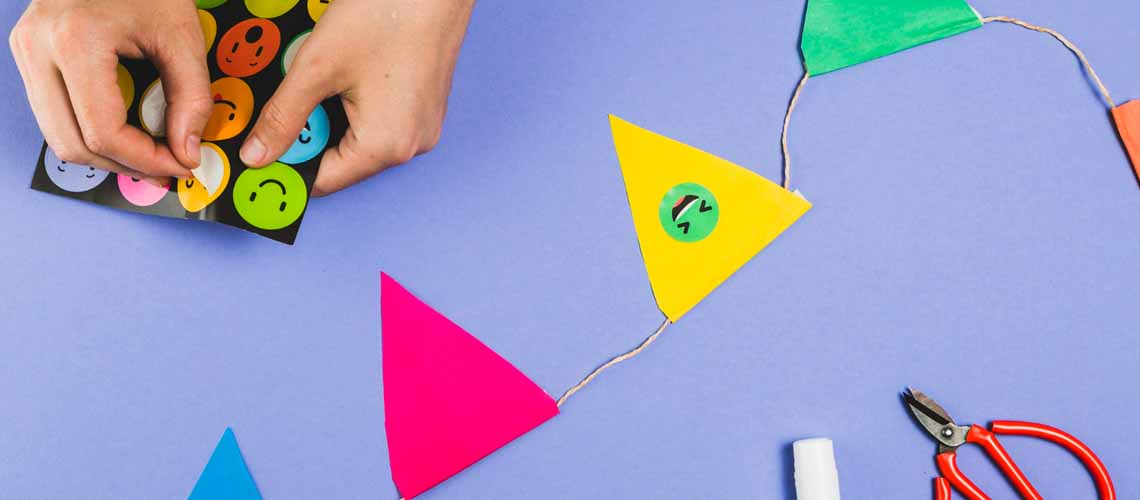
- Shape Collage Craft
Cut out various shapes, circles, squares, rectangles, and triangles, from coloured paper. Allow children to paste them on a bigger sheet to make silly pictures such as houses, rockets or flowers. This assists them in recognising every shape as they are able to develop artistic creativity. - Shape Sorting Board
Prepare cardboard or foam sheets which are divided in sections labelled for each shape. Provide cutouts of different shapes and ask children to place them in the correct spot. It is an excellent interactive maths game for preschoolers. - Geometric Animal Art
Provide children with pre cut triangles, circles, and rectangles and create animals, a triangle cat or a circular turtle shell. The practice relates art and geometry in a childish manner.
Craft Ideas for 3D Shapess
When children get used to flat shapes, add 3D shapes. These art forms allow them to feel and observe how forms are created in the real world.
- Paper Roll Towers, Cylinders and Cubes
Use old tissue rolls or cut out paper rectangles to make cylinders. Towers and castles can be built up. Cubes or cuboids can be represented by small boxes. Thus, shapes are used to create architectural structures. - 3D Shape Mobile
Cut out 3D shapes like cones, ice cream style, or cubes using paper templates. Attach them with threads in order to create a mobile of different colours. It is an excellent classroom display and a lesson of balance and symmetry. - Clay Shape Sculptures
Provide the children with modelling clay where they create spheres, pyramids or cubes. When rolling, pinching, and making shapes with the clay, they enhance fine motor control and comprehend how the 3D shapes are made.
STEM Connection: Building Geometry Skillss
Playing with shapes does not only teach you about shapes, but it is an early exposure to STEM, Science, Technology, Engineering, Mathematics. Building 3D models and exploring their dimensions enhances spatial reasoning and problem solving, which are core STEM skills.
For example, when the children build a cube with paper, they will know about edges, faces, and vertices, which are fundamental geometry concepts, and be ready to take higher grades.
Interactive Maths Games with Shapess
Add a little fun to shape learning with interactive maths games. These activities combine play and learning seamlessly:
• Shape Hunt: Ask children to find real life objects shaped like circles, rectangles, or spheres around the classroom.
• Shape Match Up: Create flashcards of 2D and 3D shapes and ask kids to match them to everyday objects.
• Shape Race: Draw shapes on the floor and let children jump to the shape you name aloud, great for kinaesthetic learners.
Benefits of Visual Learning Through Craftss
Learning would be meaningful when children observe and create shapes. Visual learning assists them to memorise more, remain active as well as think critically. It also bridges maths ideas to creativity to enable the children to be confident enough to venture into new ideas.
Quick Recaps
• Crafts make geometry fun.
• There exist 2D shapes and 3D shapes, the latter have depth.
• Creating shape crafts improves creativity, memory, and STEM skills.
• Understanding and recall is strengthened through games.
Make Learning Fun at EuroSchool
We are of the opinion that learning occurs through play at EuroSchool. Our teaching methods blend creativity and academics to make complex subjects simple and engaging. Through craft based lessons, visual learning, and interactive games, we ensure children enjoy every step of their learning journey.
Join EuroSchool today to explore the world of shapes, colours, and creativity, where learning is always fun!