From ancient storytellers who created myths based on the moon’s glow to scientists who studied its movements to comprehend time itself, the moon has always captivated humanity. The Moon’s phases, or fluctuating appearance, are among the most fascinating features of our celestial neighbour. As the Moon revolves around the Earth, reflecting different amounts of sunlight, these phases take place. Even though this may seem like a far-off astronomical event, students and enthusiasts can observe and comprehend the science behind it right here on Earth with the help of easy experiments. We can see how sunlight, the Moon, and Earth work together to create the well-known lunar cycle, from the new moon to the full moon and back again, by simulating the motion of the Moon with simple objects like a lamp and a ball.
The Moon and Its Fascinating Phases
The Moon has always fascinated children and adults alike. It changes form each night, now in the shape of a thin crescent, now of a bright and full circle. But have you ever asked yourself why that is the case? The phases of the Moon can be regarded as one of the most thrilling issues in early science education. Children can easily discover the variations in the appearance of the Moon with the help of STEM activities and fun experiments, and they can observe the night sky like little astronomers!
What Are the Phases of the Moon?
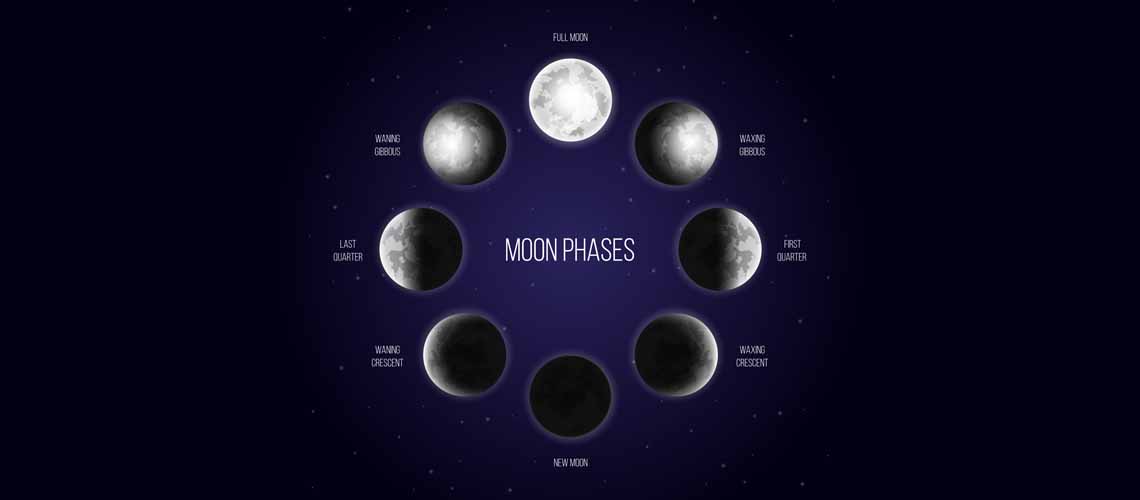
The Moon doesn’t create its own light. It reflects sunlight. As the Moon orbits the Earth, the amount of sunlight we see from our planet changes. This gives rise to the different phases of the Moon.
There are eight main Moon phases that repeat in a cycle lasting about 29.5 days:
- New Moon
- Waxing Crescent
- First Quarter
- Waxing Gibbous
- Full Moon
- Waning Gibbous
- Last Quarter
- Waning Crescent
These stages demonstrate the extent to which the surface of the Moon is exposed to the Earth as the sunlight strikes at various angles.
The Science Behind the Moon Phases
Knowing about the Moon helps children understand not only astronomy but also the connection between light, movement, and reflection. Sunlight strikes the Moon differently as it orbits the Earth and the Earth orbits the Sun. We refer to the phases of the Moon as the changing perspective of the brightened part. This is a basic concept that beginners can use as an introduction to astronomy.
Fun Hands-On Experiments to Understand Moon Phases
Let’s make learning about the Moon a hands-on experience! These simple experiments can be done at home or in the classroom using everyday materials.
The Ball and Lamp Experiment
You’ll need: a small ball (like a tennis ball), a lamp (Sun), and a dark room. Hold the ball at arm’s length and slowly move around the lamp. You’ll see the ball’s lighted part change, just like the Moon’s phases! This is one of the best hands-on science experiments to show how light creates the different Moon shapes.
Oreo Moon Phases Activity
A delicious and fun way to learn! Take eight Oreo cookies and twist them open. Scrape off the cream to represent each phase of the Moon: full, half, and crescent. Label them and arrange them in order. This tasty activity makes science activities for children both fun and memorable.
Flashlight and Styrofoam Moon Demo
You’ll need a flashlight (Sun), a Styrofoam ball (Moon), and a pencil. Stick the ball on the pencil and shine the flashlight from one side. Rotate the ball to see how the light changes, just like when the Moon orbits Earth. A simple STEM activity for kids that makes abstract concepts easier to understand.
Moon Phase Calendar Project
Encourage children to observe the Moon every night for a month and draw what they see. At the end, they’ll have a visual record of all the Moon’s phases. This promotes observation and patience, essential skills in science learning.
Shadow Box Moon Model
Create a simple box with cutouts representing different Moon phases. Take a small flashlight and place it inside, along with a white ball to represent the Moon. Children can move the Moon and observe how the light falls on it from different angles. An ideal experiment for classrooms with visual learners!
Observing the Moon at Home
You don’t need a telescope to enjoy exploring astronomy! Encourage your child to look at the Moon regularly from balconies, gardens, or windows. Keep a ‘Moon Journal’ where they can draw what they see each night. In the long run, they will observe the changes in the shape and brightness of the Moon.
You can also download free Moon phase charts or apps to track the lunar cycle together. This simple family activity encourages curiosity and learning through play, turning bedtime into a moment of scientific wonder.
Connecting Moon Phases to STEM Learning
Moon phase experiments are excellent STEM activities for kids, integrating science, technology, engineering, and math concepts. Through hands-on exploration, children learn how celestial bodies move and interact. These activities enhance critical thinking, observation, and problem-solving skills, essential tools for young learners in early education.
Tips for Parents and Teachers
Here’s how adults can make learning about Moon phases more engaging:
- Use storytelling: relate Moon phases to bedtime stories or myths about the Moon.
- Include art: let children paint or craft each phase using clay or paper plates.
- Take photos: compare how the Moon changes each week.
- Encourage questions: like “Why does the Moon look different every day?” and discuss answers together.
Final Thoughts
This is not just a heavenly marvel as the Moon orbits the Earth. It is the ideal time to introduce children to science by means of playing. Through observation, experimentation, and reflection, children can grasp complex concepts in a simple, visual way. Understanding Moon phases through experiments turns curiosity into discovery and learning into fun!
At EuroSchool, we believe science learning begins with curiosity and exploration. Our curriculum includes interactive science activities for children and hands-on experiments that make complex ideas simple and exciting.