The development of AI in the educating world is changing how the schools teach and students learn. Artificial intelligence (AI) tutors or learning systems that are personalized and designed to enhance learning experience are becoming useful in both of the aspects with respect to teachers and students in 2025.
1. Why Logical Thinking Matters
Logical thinking is the ability to analyse situations, find patterns, and arrive at conclusions using reasoning. It is what makes children solve arithmetic, get to know basic science experiments and even playground disputes.
When your child learns to think logically:
- They are able to make more effective associations
- They gain confidence about problem-solving
- They make better decision-makers in life
- Their grades also go up particularly in disciplines such as Math and science
2. The Power of Puzzles: Learning Through Play
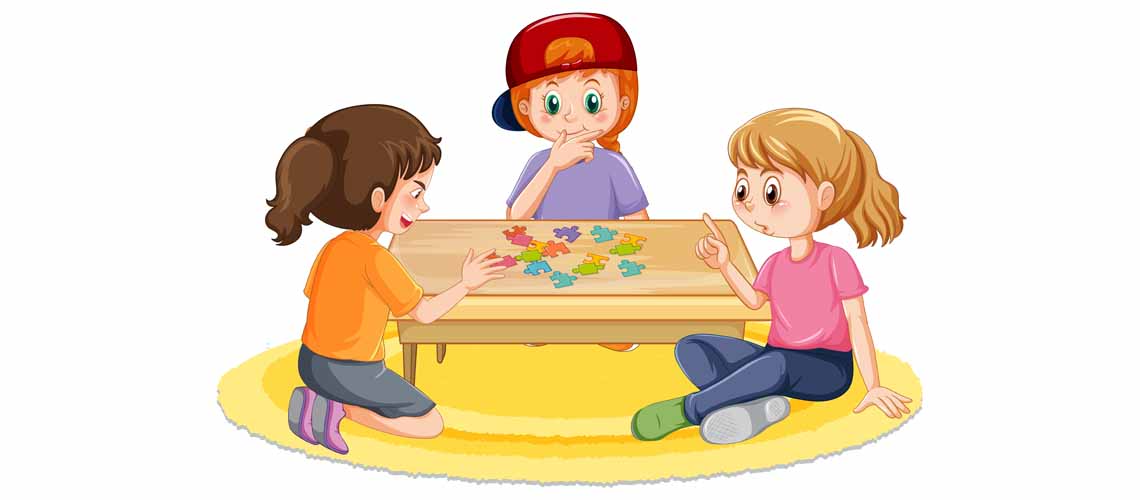
Puzzles are not merely toys, it is a cognitive development tool. It can be in making missing pieces in a jigsaw puzzle or solving a Sudoku puzzle, the steps all require critical thinking.
Here’s how puzzles help your child:
- Improve Concentration
- Enhance Observation Skills
- Boost Memory
- Encourage Perseverance
- Develop Teamwork
3. Types of Puzzles That Build Logical Reasoning
Here are some fun puzzles for kids that you can introduce at home or in play-based learning:
- Jigsaw Puzzles
It is ideal when used by younger children. These assist in recognition of visuals, recognition of patterns and association of shapes and colours. - Math Puzzles
For slightly older kids, math puzzles improve numerical reasoning and logical deduction. For example:
“If 2 pencils cost ₹10, how many pencils can you buy with ₹50?”
- Riddles and Brain Teasers
Classic brain teasers to students such as:
“I’m tall when I’m young and short when I’m old. What am I?” (Answer: A candle!) - Logic Grid Puzzles
These puzzles entail the need to use clues to get the right match among people, objects, or even events, and hence they are very good in the development of analytical skills. - Word and Pattern Puzzles
The best way to enhance verbal reasoning and sequence ability is through crosswords, missing letters games or pattern sequences.
4. Everyday Ways to Use Puzzles at Home
You do not need some expensive games or puzzle books. You can use logical reasoning puzzles during your day-to-day activities. Here’s how:
- Morning Challenge: Start your child’s day with a small brain teaser.
- Puzzles at the Dining Table: Use food items for quick puzzles.
- Family Puzzle Time: Dedicate 15 minutes each evening to a group puzzle.
- DIY Puzzles: Encourage your child to make their own puzzles.
5. Fun Logical Reasoning Puzzle Ideas
Here are three quick puzzles you can try with your child:
Puzzle 1: The Coin Challenge
You have 3 coins that together make ₹30. One of them is not a ₹10 coin. How is that possible?
Puzzle 2: The Missing Number
2, 4, 8, 16, ? (Answer: 32 — doubles each time.)
Puzzle 3: The Bridge Crossing Puzzle
Four friends must cross a bridge at night with one torch. At most two can cross at a time. What is the best way to get across all?
6. Benefits of Puzzles for Kids
Let’s summarise the benefits of puzzles for kids and why they’re worth including in your child’s daily playtime:
- Increases patience: Perseverance and focus.
- Builds reasoning ability: Logical and analytical skills.
- Enhances spatial awareness: Visual intelligence.
- Strengthens memory: Recall and attention.
- Boosts problem-solving: Critical thinking.
- Encourages independence: Self-confidence.
7. Encouraging a Growth Mindset Through Puzzles
One of the best things puzzles teach children is the value of persistence. When children are working on a complex puzzle, they get to think in a different perspective, explore new concepts, and not give up so quickly. These experiences build a growth mindset—the belief that effort and patience lead to improvement.
8. How EuroSchool Makes Learning Logical and Fun
At EuroSchool, we incorporate logical thinking in a daily classroom learning process at EuroSchool in the form of interactive games, problem-solving, and inquiry. Our teachers know that reasoning becomes most effective when children are left to reason, ask questions and be imaginative.
From story-based riddles to STEM-inspired puzzles, we make sure every child develops not just intelligence, but curiosity and confidence too.
If you want your child to learn through play, think smart, and grow with joy, visit EuroSchool today and discover how we make logic fun and learning lifelong!