A good moral story can teach a lesson without feeling like a lecture. When a child hears the story of the boy who cried wolf, they can understand why lying is wrong without being told.
Below are five short moral stories for kids. Each takes two to four minutes to tell and ends with a clear moral. They are written in simple English, making them easy to share at bedtime, in preschool or in the classroom.
You’ll also find why these stories matter, tips for telling them, and answers to common questions from parents.
Why Moral Stories Matter for Kids
Young children understand ideas better when they can see them in a story. “Be honest” can be hard for a five-year-old to understand, but a story about a shepherd boy who loses everyone’s trust makes the lesson easier to grasp.
A short moral story can help children:
Understand values: Kindness becomes something they can see and understand, not just a word.
Talk about feelings: Children learn to name what characters feel and talk about their own feelings.
Understand actions and consequences: Stories show children that what we do can have consequences.
Build attention: Following a short story with a beginning, middle and end helps children develop their listening skills.
Create shared family moments: A story can give parents and children a simple way to talk about everyday lessons.
The same story can also mean different things at different ages. A three-year-old may enjoy The Tortoise and the Hare as a fun race, while an older child may notice the lesson about patience and persistence.
Short Moral Stories for Toddlers and Preschoolers (Ages 2–5)
Keep these stories under two minutes, use fun voices, and don’t worry if your child asks for the same one every night. Repetition helps the lesson stick.
1. The Lion and the Mouse
Teaches: Kindness and how everyone can help
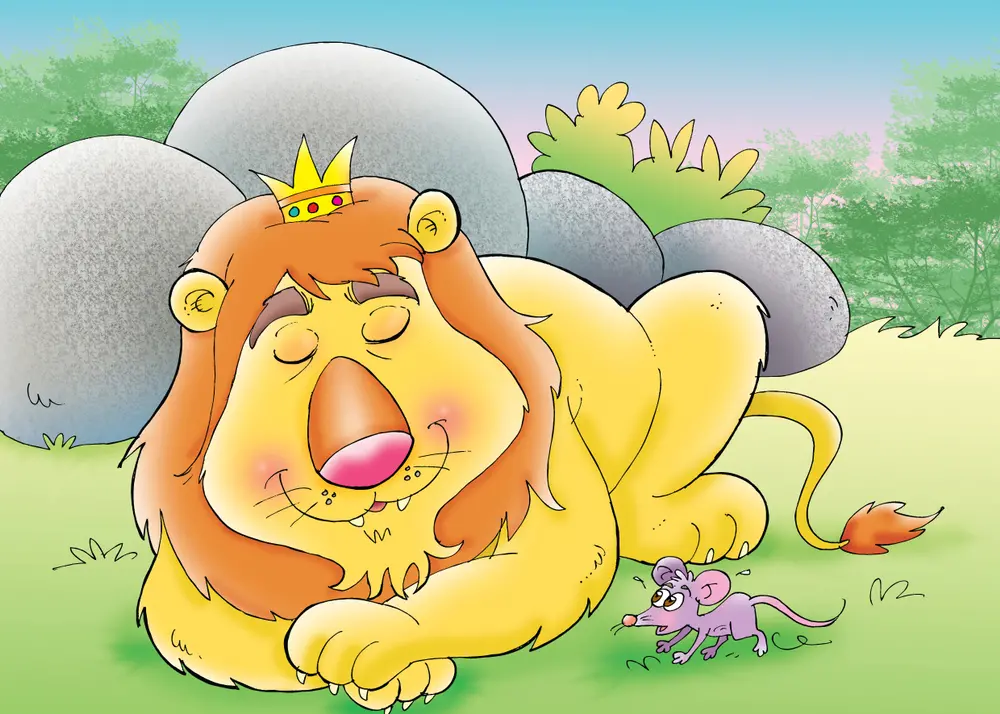
A big lion was sleeping under a tree when a tiny mouse ran over his paw and woke him.
The lion grabbed the mouse. “I’m going to eat you!” he roared.
“Please let me go,” squeaked the mouse. “One day I will help you.”
The lion laughed. How could a tiny mouse ever help a lion? Still, he let her go.
A few days later, hunters caught the lion in a rope net. He roared for help. The little mouse heard him and ran over. She nibbled through the ropes until the lion was free.
“You were right, little friend,” said the lion. “Small friends can do big things.”
Moral: A small act of kindness can make a big difference.
Talk about it: What is one small thing you can do to help someone today?
2. The Thirsty Crow
Teaches: Keep trying and think of new ways
It was a hot day. A crow flew around looking for water. At last, she saw a pot in a garden.
There was water at the bottom, but her beak could not reach it.
The crow did not give up. She spotted some small stones nearby and dropped one into the pot. The water rose a little.
She dropped in another stone, then another. Slowly, the water rose until she could reach it and have a cool drink.
Moral: When something is hard, don’t give up. Try another way.
Talk about it: What could you try the next time something feels too hard?
3. The Tortoise and the Hare
Teaches: Patience and not showing off
A hare loved to boast. “I am the fastest animal in the forest!” he said.
A tortoise got tired of hearing it. “Let’s race,” she said.
The hare ran ahead. He was so far in front that he stopped for a nap under a tree.
The tortoise kept going. Step, step, step. She never stopped. She walked past the sleeping hare and reached the finish line first.
When the hare woke up, everyone was cheering for the tortoise.
Moral: Keep going, even if you are slow. Slow and steady wins the race.
Talk about it: What is something you got better at by practising every day?
4. Tara Waits Her Turn
Teaches: Patience and taking turns
Tara loved the big red slide in the park. But today, there was a long line of children waiting.
Tara tried to squeeze in at the front. A little boy fell and started to cry.
Tara felt bad. She helped him up and went to the back of the line.
The line moved. Three, two, one. Now it was Tara’s turn!
“Whoosh!” She went down the slide. It was even better because everyone had got a turn.
Moral: Waiting your turn is kind, and your turn will come.
Talk about it: What can you do while you wait for your turn?
5. The Little Elephant Who Wanted to Help
Teaches: Everyone can help in their own way
Bindu was the smallest elephant in the herd. The bigger elephants were carrying heavy logs to build a wall by the river. Bindu wanted to help too.
“You are too little,” said her uncle. “The logs are too heavy.”
Bindu felt sad. Then she noticed that the big elephants were hot and tired. She filled her trunk with cool river water and sprayed it over their backs.
“Ahh, that feels wonderful!” said her uncle.
Soon, every elephant was lining up for Bindu’s cool shower. The wall was built, and Bindu had helped after all.
Moral: You don’t have to be big to be helpful. Find your own way to help.
Talk about it: What is one thing you can do to help at home?
How to Tell a Moral Story So It Sticks
Reading the story is easy. These simple tips can help your child remember the lesson.
Choose the right story
Younger children need simple stories with one character, one problem and a happy ending. Older children can enjoy stories with twists and more complex lessons.
Use your voice
Give the lion a big roar and the mouse a tiny squeak. Change your voice to make the story more fun and memorable.
Ask questions
Pause before the ending and ask, “What do you think will happen?” or “What should the hare have done?” This helps children think about the lesson.
Connect it to everyday life
“Remember when you shared your crayons? That was kind.” This helps children connect the story to their own actions.
Let them retell it
Ask children to tell the story back to you or to a family member. This helps build memory and confidence.
Repeat the story
If your child wants to hear the same story every night, that’s fine. Repetition helps the lesson stick.
Change the details
Use your child’s name or a familiar place in the story. This can make it feel more personal.
FAQ: Moral Stories for Children
At what age can I start telling moral stories?
You can start around age two. Toddlers may not understand the moral at first, but they enjoy the rhythm, voices and pictures the story creates in their minds. By four or five, many children start to talk about what a story means.
How long should story time be?
Keep it short. Two to five minutes is enough for toddlers, five to ten minutes for preschoolers, and up to 15 minutes for older children. Stop while they are still enjoying the story.
Should I always explain the moral at the end?
Not always. With older children, ask them what they think the story teaches before telling them the moral. If they have a different idea, talk about why they understood the story that way.
Is it okay if a story has a sad or scary part?
Yes, as long as it is brief and age-appropriate. A little tension can make the lesson more meaningful. Keep the scary part short, use a calm voice, and reassure younger children at the end.
Can I change the stories?
Absolutely. You can rename the characters, set the story in a familiar place or change some details. These tales have been retold for thousands of years, so there is no need to tell them exactly the same way every time.
What’s the difference between fables, Panchatantra tales and moral stories?
Fables are short stories, often with animal characters, that usually end with a moral. Aesop’s fables are linked to ancient Greece. The Panchatantra is a collection of stories from ancient India that was written to teach young princes about wise living. Both are types of moral stories. This list includes stories inspired by both, along with a few folk tales and two original stories.
Start With One Story Tonight
You don’t need all ten. Pick one that suits your child’s age, tell it at bedtime, and ask the question at the end. Then tell it again tomorrow.
These stories have been passed from parents to children for centuries because their simple lessons stay with us. A lion, a mouse, a crow with a pot of water – these may be small tales, but the lessons they carry can stay with children for years.
Bookmark this page for the next rainy afternoon, and share it with a parent or teacher looking for a few good stories.
If you’re looking at preschools, learn more about how EuroNova supports children in their early years at EuroSchool.