Since the beginning of time, humans have looked up at the stars in wonder. From ancient civilizations tracking the movement of the sun and moon to today’s space telescopes capturing galaxies millions of light-years away, astronomy has always sparked curiosity. For students and educators, exploring the universe phenomena is not just about science; it’s about imagination, discovery, and connecting with something bigger than ourselves.
Let’s look at some of the most fascinating astronomy events, amazing universe facts, and ways to engage in night sky observation that deepen our understanding of planets and stars.
Why Astronomy Matters in Education
Astronomy goes beyond textbooks. It teaches us to ask big questions: Where do we come from? What is our place in the universe? For students, learning about planets and stars nurtures curiosity, critical thinking, and problem-solving skills. For teachers, it’s an opportunity to inspire awe and connect science to daily life.
Fascinating Astronomy Events You Shouldn’t Miss
Every year, the sky presents breath-taking spectacles. Here are some highlights that can be observed even without a telescope:
1. Solar and Lunar Eclipses
- Solar eclipses occur when the moon blocks the sunlight. Lunar eclipses happen when Earth casts its shadow on the moon.
- Both remind us of the harmony and alignment of celestial bodies.
2. Meteor Showers
- Events like the Perseids or Geminids light up the night sky.
- These occur when Earth passes through streams of cosmic dust left by comets.
3. Planetary Alignments
- Sometimes, multiple planets and stars line up in the same part of the sky, visible to the naked eye.
- Such events inspire wonder and are perfect for school sky-watching activities.
4. Supermoons
- When the moon appears larger and brighter than usual, it’s a reminder of how dynamic our night sky really is.
5. Comets and Asteroids
- Though rare, the appearance of a bright comet becomes a generational event.
Mind-Blowing Universe Facts for Students
Here are some fascinating universe facts that always capture students’ imagination:
- The sun accounts for 99.8% of the mass of our solar system.
- Light from the nearest star, Proxima Centauri, takes over 4 years to reach us.
- Jupiter is so massive it could fit more than 1,300 Earths inside it.
- There are more stars in the universe than grains of sand on Earth’s beaches.
- Some galaxies are moving away from us faster than the speed of light due to cosmic expansion.
These facts remind us that the universe is not just vast but constantly evolving.
Understanding Universe Phenomena
Beyond the visible sky, astronomers study remarkable universe phenomena that challenge our imagination:
- Black Holes: Regions where gravity is so strong that nothing, not even light, can escape.
- Nebulae: Giant clouds of gas and dust where stars are born.
- Exoplanets: Planets orbiting stars outside our solar system, some in “habitable zones.”
- Supernovae: Explosions of massive stars, scattering elements essential for life.
- The Big Bang: The origin theory of the universe, explaining how it all began 13.8 billion years ago.
Night Sky Observation: A Hands-On Experience
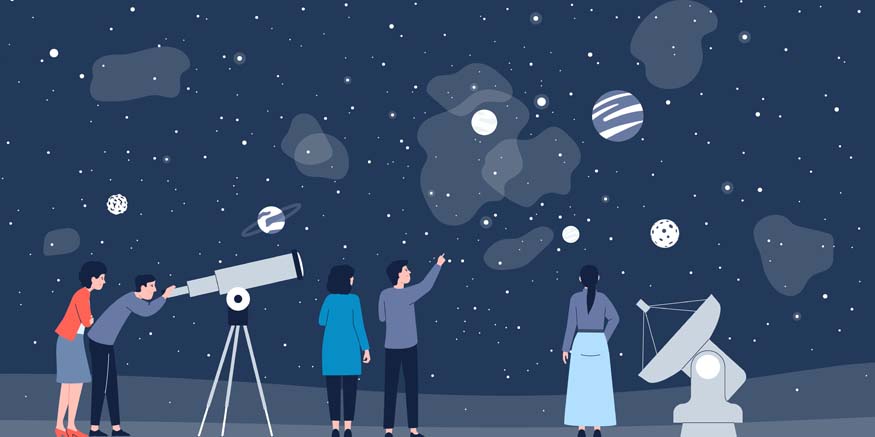
Nothing excites students more than direct night sky observation. Schools and parents can encourage:
- Star Gazing Sessions: Identify constellations like Orion or Ursa Major.
- Planet Watching : Jupiter’s moons and Saturn’s rings are visible with small telescopes.
- Tracking the Moon Phases: A great way to understand the lunar cycle.
- Using Astronomy Apps: Mobile apps help identify planets and stars in real-time.
Engaging in these activities not only strengthens scientific understanding but also builds patience and wonder.
Step-by-Step Guide for Teachers and Students
- Start Small – Begin with simple observations of the moon and bright stars.
- Learn the Basics – Understand constellations and planet positions.
- Use Tools – Binoculars or beginner telescopes make a huge difference.
- Keep a Journal – Record observations, sketches, and reflections.
- Stay Updated – Follow space agencies for upcoming astronomy events.
Frequently Asked Questions (FAQs)
Q1. What are the most important astronomy events for students to observe?
Solar/lunar eclipses, meteor showers, supermoons, and planetary alignments are the most engaging and easy-to-watch events.Q2. How do planets and stars differ?
Stars produce their own light and heat, while planets reflect the light of stars and orbit around them.
Q3. What are some interesting universe phenomena?
Black holes, nebulae, exoplanets, and supernovae are among the most fascinating phenomena studied by astronomers.
Q4. How can students start night sky observation?
Start by identifying bright constellations and the moon with the naked eye, then gradually use binoculars or apps for deeper exploration.
Q5. Why is astronomy important for students?
It encourages curiosity, scientific thinking, and an appreciation of our place in the vast universe.
Final Thoughts: The Universe as a Classroom
Astronomy teaches us humility, patience, and the beauty of discovery. By learning about astronomy events, exploring planets and stars, and marvelling at universe phenomena, students not only expand their knowledge but also their imagination.
The night sky is a classroom without walls, one that sparks curiosity and connects us to something much larger than ourselves.
Why EuroSchool is the Perfect Partner in Cosmic Learning
At EuroSchool, we believe that education should expand beyond textbooks to include the wonders of the universe. Our programs integrate:
- Astronomy Clubs for hands-on night sky observation
- STEM Activities to encourage curiosity in science and space
- Creative Projects where students explore universe facts through models, charts, and presentations
- Future-Ready Learning that develops analytical thinking, curiosity, and a sense of exploration
At EuroSchool, every child is encouraged to dream big, beyond the stars. With expert mentorship and modern learning methods, we prepare students to discover not just the world, but the universe.
Take the first step towards inspiring your child’s curiosity with EuroSchool today!