
Top CBSE Schools in India: A Parent’s 2026 Guide to Choosing the Right Fit (Without the Confusion)
If you’re reading this, you’re probably doing what most thoughtful parents do before admissions season: trying to separate “good on paper” from “actually good for my child.” When people search CBSE Schools in India, they’re rarely just looking for names. They’re looking for signals safety, academic strength, teacher quality, a healthy school culture, and whether the school can support a child who is curious, anxious, advanced, average, artistic, sporty, or all of the above.
And yes many parents also search for top cbse schools in India because the stakes feel high, and no one wants regret after the first term begins.
This guide is designed to help you evaluate CBSE schools like an insider using clear criteria, parent-friendly questions, and practical ways to verify what a school claims (without getting overwhelmed). Toward the later part of the blog, we’ll also map these criteria to how EuroSchool approaches CBSE education so you can compare with your checklist, not with someone else’s marketing.
Mini Table of Contents
- What makes a CBSE school “top,” realistically, for your child?
- How can you verify a school’s CBSE affiliation the right way?
- How many CBSE schools in India are there and why the number matters less than you think
- CBSE vs ICSE vs IB vs IGCSE: how to choose without second-guessing
- What should you check in academics (beyond marks and board results)?
- What should you check in teachers, leadership, and classroom culture?
- What should you check in student wellbeing, safety, and discipline?
- What should you check in infrastructure and learning resources?
- What should you check in fees, value, and “hidden costs”?
- What should you check in the admissions process (and what questions to ask)?
- So where does EuroSchool fit into this checklist?
- Top CBSE schools to consider
- FAQs parents ask before choosing a CBSE school
1) What makes a CBSE school “top,” realistically, for your child?
Let’s start with a slightly uncomfortable truth: a “top” school on someone else’s list can be a stressful mismatch for your child.
In parent terms, a truly strong CBSE school usually gets four things right consistently, not occasionally:
A. It teaches concepts, not just chapters
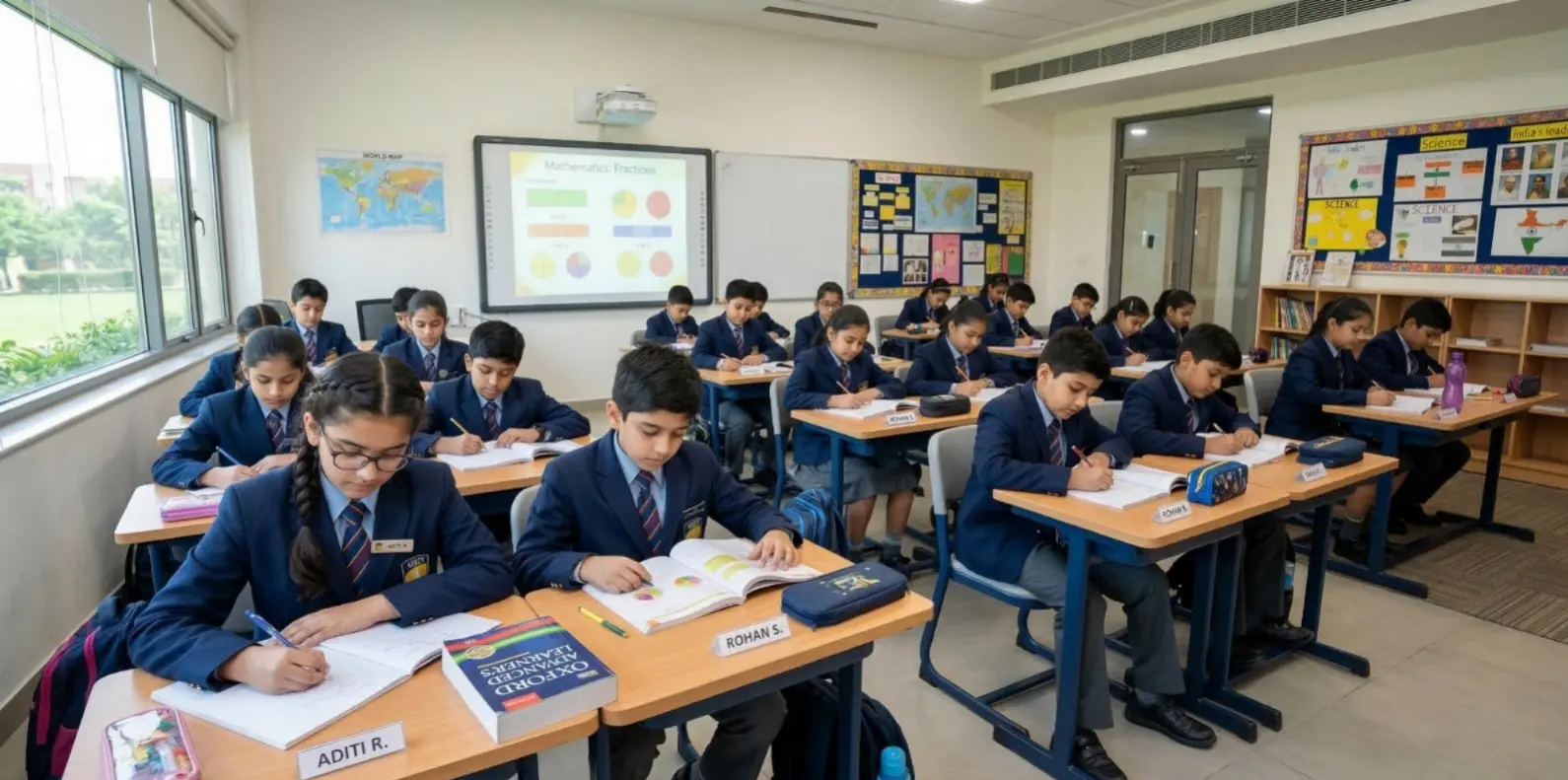
CBSE is structured, and the curriculum aligns closely with NCERT. But the quality of a CBSE school shows up in how those concepts are taught especially in maths, science, languages, and social science.
Ask for a sample lesson plan or classroom practice. A good sign is when the school can clearly explain how they build conceptual understanding and revision cycles without making it sound like a coaching centre.
“CBSE” tells you the framework. Teaching quality tells you the outcome.
B. It maintains academic seriousness without turning childhood into a race
The best CBSE environments balance high expectations with emotional safety. Your child should feel challenged, but not constantly compared.
Ask how they respond when a child is struggling do they label, punish, or support?
A strong school protects your child’s confidence while improving competence.
C. It has systems safety, communication, academic tracking
A school can have beautiful infrastructure and still feel chaotic. Parents often sense this within the first 30 minutes of a campus visit: unclear answers, inconsistent policies, “we’ll see later” responses.
Ask how the school tracks learning progress and communicates concerns monthly, term-wise, or only when there’s a problem?
Systems are what make a school reliable.
D. It builds the child, not just the report card
CBSE schools can absolutely support holistic development, but only if co-curricular, sports, arts, and life skills are structured not treated as optional filler.
Ask for the weekly timetable split between academics, physical education, arts, clubs, and skill-based learning.
A “top” school develops thinkers, not just test-takers.
2) How can you verify a school’s CBSE affiliation the right way?
This is one of the most important steps and surprisingly, many parents skip it because it feels technical. But you don’t need inside knowledge. You just need the right source.
The simplest, most reliable method: use the CBSE SARAS school directory
CBSE’s official affiliation system and directory are hosted through the SARAS portal. The directory allows you to check affiliated schools and related details.
What to do in practice:
- Search the school by name, keyword, or affiliation number on the official directory.
- Confirm the status and ensure the listing matches the campus you’re visiting (chains can have multiple campuses; not all may have the same board or grade coverage).
What this protects you from:
- Mistaken assumptions (“They said CBSE, so it must be CBSE”)
- Outdated affiliations
- Confusion between a brand name and a specific campus
Don’t treat affiliation as a brochure claim. Treat it like a verification step.
3) How many cbse schools in India are there and why does the number matter less than you think?
Parents ask this question because they’re trying to understand the scale: “If there are so many CBSE schools, how do I pick the right one?” CBSE’s official SARAS directory shows Total No. of Schools affiliated with CBSE: 32,566 (as displayed on the directory).
Now here’s the important part:
A big number doesn’t make your decision easier it makes your filtering system more important.
Instead of starting with “best list,” start with “best fit.” A school that is perfect for a highly independent child may be overwhelming for a child who needs steady emotional support and smaller transitions. The question isn’t “How many exist?” The question is “Which few match my child and our family values?”
4) CBSE vs ICSE vs IB vs IGCSE: how to choose without second-guessing
A lot of parent stress comes from curriculum confusion. And honestly, it’s understandable because people talk about boards like they’re personality types. Here’s a clean, parent-first way to think about it:
CBSE (Central Board of Secondary Education)
CBSE is widely chosen for its national recognition and alignment with NCERT-based learning. Many families prefer it for structured progression and familiarity across cities and school transitions. EuroSchool’s own CBSE curriculum guidance also highlights the NCERT-aligned structure and its relevance for national-level competitive pathways.
Parent lens:
- Good for families who may relocate within India
- Often preferred when a child is likely to pursue standard Indian entrance pathways (depending on the child and school approach)
ICSE
Often perceived as language-rich and detailed in approach, though the experience can vary widely by school.
Parent lens:
- Can suit children who enjoy reading/writing depth and consistent project work
- Requires a school that manages workload thoughtfully
IB / IGCSE
Often chosen for global frameworks, inquiry-driven learning, and different assessment styles but again, school implementation matters more than the label.
Parent lens:
- Works best when families understand the learning style and are comfortable supporting independent learning habits
- Great if a child thrives in research-based, discussion-led classrooms (when done well)
Boards don’t raise children schools do. Choose the board, then choose the implementation quality.
5) What should you check in academics (beyond marks and board results)?
If you’ve ever attended a school orientation where everything sounds impressive smart boards, labs, “21st-century skills” but you still walk out unsure, this section is for you.
Here’s what actually matters academically:
A. How does the school build foundational learning in primary years?
The quality of Grades 1–5 shapes everything later. A school may boast high Class 10 results, but if the early years are rushed, children often develop shaky confidence in maths, reading comprehension, and writing.
What to ask:
- How do you ensure reading fluency and comprehension by Grade 3?
- How do you build number sense not just procedures in maths?
Ask for examples of how the school supports different learning speeds. The best schools don’t treat variation as a problem; they plan for it.
Strong primary academics reduce stress in middle school.
B. What is the school’s approach to assessment?
Parents should look for balanced assessment not constant testing, not zero structure either.
What to ask:
- How often are assessments done, and how are they used?
- Do teachers share actionable feedback, or only marks/grades?
Good sign: You hear about feedback loops, concept checks, remedial plans, and enrichment not just “unit tests and term exams.” Assessments should guide learning, not just label children.
C. Does the school support academic depth without turning it into coaching?
Some schools quietly become “tuition-dependent systems” where families feel forced into external coaching to keep up.
What to ask:
- How do you support exam readiness within school time?
- How do you handle students who need more practice do you provide additional support?
A good school reduces the need for constant external patchwork.
6) What should you check in teachers, leadership, and classroom culture?
If you remember only one thing from this blog, let it be this: Your child’s daily experience is shaped more by teachers than by facilities. Here’s what to look for:
A. Teacher stability and development
Frequent teacher turnover affects learning continuity and emotional security, especially in primary years.
What to ask:
- What is your teacher retention like?
- How do teachers receive training and mentoring?
EuroSchool positions its ecosystem as teacher-led and training-focused, with an emphasis on structured pedagogy and teacher preparation.
Stability and training matter more than “famous infrastructure.”
B. Classroom culture: fear-based or curiosity-based?
Many parents underestimate how much classroom tone affects learning. A child who feels safe asks questions. A child who feels judged becomes quiet even if they are capable.
What to ask:
- How do teachers respond to incorrect answers?
- Do you encourage questioning and discussion?
Curiosity is a stronger predictor of long-term success than short-term compliance.
C. Leadership accessibility
In strong schools, leadership is visible not necessarily “available 24/7,” but structured, responsive, and clear.
What to ask:
- Who handles academic concerns?
- How quickly are parent queries typically resolved?
Clear communication systems reduce family stress.
7) What should you check in student wellbeing, safety, and discipline?
This is where many parents’ instincts are correct: a school can be academically strong and still be emotionally unsafe.
A. Safety is both physical and emotional
Physical safety includes campus access control, transport safety, supervision ratios, and age-appropriate infrastructure. Emotional safety includes how the school handles bullying, humiliation, exclusion, and peer conflict.
What to ask:
- What is your anti-bullying process?
- How do you handle conflicts punishment-first or resolution-first?
Policies matter, but implementation matters more ask for real examples.
B. Discipline: “silent obedience” vs “self-management”
Good discipline should build self-regulation, responsibility, and respect not fear.
What to ask:
- How do you handle repeated behavioural issues?
- Do you have counselling or wellbeing support?
The goal is a child who behaves well because they understand, not because they are scared.
8) What should you check in infrastructure and learning resources?
Infrastructure is important but not in the “Instagram tour” way.
What matters most:
- Classroom ergonomics (space, light, ventilation, seating)
- Science and computer labs (usage frequency, not just existence)
- Libraries (reading culture, not just book count)
- Sports facilities (structured coaching, safety, inclusivity)
- Arts and performance spaces (actual time allocated)
Ask how often children use labs, libraries, and sports facilities weekly. A facility that is “there” but rarely used is just décor.
Utilisation beats possession.
9) What should you check for fees, value, and “hidden costs”?
Parents often compare fees like a shopping price tag, but schooling is more like a service ecosystem.
What to clarify (politely, but clearly):
- Annual fee structure and what it includes
- Transport fees and routes
- Books, uniforms, devices (if any)
- Activity charges, trips, events
- Any one-time admission charges and refund policies (as applicable)
Ask for a written fee sheet, and ask what typically changes year-to-year.
The best financial clarity is upfront clarity.
10) What should you check in the admissions process and what questions to ask?
Admissions can be emotional because parents feel judged and children feel it too. A strong school admissions process should feel structured, respectful, and child-sensitive.
What a healthy admissions process looks like:
- Clear timelines and documentation
- Age-appropriate interactions with the child
- Transparent communication on what the school is evaluating
- Orientation that explains “how learning works here,” not just “how to pay fees”
Parent questions that reveal quality fast:
- How do you support a child who is shy or anxious in the first month?
- How do you communicate learning progress to parents what does that look like?
- What does a typical school day look like in this grade?
- How do you handle learning gaps support within school or “manage at home”?
- What is the school’s approach to homework in primary vs middle grades?
The admissions process is your preview of how the school will treat families later.
11) So where does EuroSchool fit into this checklist?
Now that you have a parent-first framework, let’s apply it to EuroSchool without assuming it’s automatically the “right” choice for everyone. The point is to see whether it matches what you value.
A. Curriculum approach: structured CBSE with a broader learning lens
EuroSchool’s CBSE content explains the NCERT alignment and the overall structure expected in CBSE learning.
Separately, EuroSchool also describes a NEP-aligned approach and structured instructional design principles (including the way lessons are organised to build engagement and understanding).
What this can mean for parents in real life:
If your child needs structure but also learns best through activity, discussion, and practical application, you’ll want to see how the campus translates curriculum into classroom experience especially in primary and middle years.
Parent guidance: On a campus visit, ask to see:
- How reading is taught in early grades
- How maths concepts are built beyond worksheets
- How science learning includes demonstrations, experiments, and observation not just notes
Look for implementation: “Show me how this looks on a normal Tuesday.”
B. Whole-child development: not as an add-on
Many parents worry that CBSE schools can become marks-only environments. EuroSchool’s recent communication and campus updates lean into co-curricular development as a meaningful part of schooling culture, including dedicated learning spaces for arts and co-curricular exploration.
Ask how the school protects co-curricular time during exam-heavy periods. A school that truly values balance won’t cut sports and arts the moment pressure rises.
Balance is proven by the timetable, not by slogans.
C. Scale and consistency across campuses (with a parent caution)
EuroSchool describes itself as a network across multiple major cities, and its “About” page outlines the growth and presence across locations.
Parent caution: In any multi-campus group, the campus-level leadership matters a lot. Two campuses can share the same philosophy but feel different in day-to-day culture depending on the principal, teacher stability, and parent communication practices.
If you’re considering EuroSchool, treat your evaluation as campus-specific:
- Ask about teacher retention at that campus
- Ask about grade availability (some campuses may offer different grade ranges)
- Ask about board affiliation for that campus and verify via the official directory where applicable
Judge the campus your child will attend, not just the brand.
D. Who EuroSchool may suit best (as a “fit” statement, not a guarantee)
Based on EuroSchool’s stated emphasis on structured pedagogy, co-curricular investment, and child-centric schooling systems, it may suit families who want:
- A CBSE-aligned path with a broader skill and experience layer
- A school culture that tries to balance academics with whole-child development
- Clear parent communication structures and organised learning environments (best assessed during your campus interactions)
If your checklist includes both academics and child wellbeing as non-negotiables, EuroSchool is worth evaluating through the questions in this blog.
List of Top Relevant Schools to Shortlist
If you’ve been searching CBSE Schools in India and feeling like every “top” list is either too generic or too salesy, one parent-friendly way to narrow things down is to shortlist a few campuses from one trusted school group and then evaluate them properly using the checklist you’ve already built (teaching quality, wellbeing, consistency, communication, and real classroom practice).
EuroSchool states it operates a network of 18 K–12 schools across Mumbai, Pune, Bengaluru, Hyderabad, and Surat and it also publishes campus-level location clusters for each city. (Important parent note: board offering and grade coverage can differ by campus, so treat this as a shortlist then verify campus specifics via the school and official affiliation directory where applicable.)
EuroSchool campuses parents commonly shortlist by city
| City | EuroSchool locations (campus areas) to shortlist |
| Bengaluru | Chimney Hills, Yelahanka (North Campus), Bannerghatta, Whitefield, HSR, Electronic City (EuroSchool) |
| Mumbai / Thane belt | Airoli, Thane, Upper Thane, Dombivli, Balkum (EuroSchool) |
| Pune | Undri, Kharadi, Wakad (EuroSchool) |
| Hyderabad | Metro Garden, Hitech City (EuroSchool) |
| Surat | Surat (EuroSchool lists Surat as part of its network) (EuroSchool) |
How to use this shortlist like a practical parent (not like a brochure reader)
- Step 1: Pick 2–3 campuses max that work for your commute and your child’s daily stamina. A “great” school that exhausts your child through travel often backfires by mid-year.
- Step 2: Confirm campus-specific details (board, grade range, admissions timelines) directly with that campus. EuroSchool provides official contact and admissions routes for campus enquiries. (EuroSchool)
- Step 3: Validate CBSE affiliation where relevant using the official CBSE school directory (especially helpful when comparing campuses or similarly named schools). (EuroSchool)
- Step 4: Visit with your checklist and ask for examples: how they teach reading in early grades, how they handle learning gaps, what classroom discipline looks like, and how feedback is shared with parents.
Small but powerful parent takeaway: the “top” school is usually the one that is predictably good on ordinary days not just impressive on open-house day.
Conclusion: how to choose with confidence (and fewer regrets)
The fastest way to feel confident about choosing a school is not to collect more opinions it’s to ask better questions and verify the basics. When parents search CBSE Schools in India, what they usually want is reassurance: “Am I choosing well for my child?” The reassurance comes from clarity.
So use this approach:
- Verify CBSE affiliation through official sources
- Evaluate teaching quality through examples, not brochures
- Check wellbeing systems and classroom culture
- Understand total costs and communication practices
- Choose the school that fits your child’s temperament, not someone else’s status list
If you’re comparing EuroSchool, keep it simple: walk in with this checklist, ask for real examples, and notice whether answers feel clear, consistent, and child-aware. That’s how you make a decision you won’t need to keep defending yourself later.
FAQ: What most parents want to know about CBSE Schools in India
1) What is the best way to verify if a school is CBSE-affiliated?
Use the official CBSE SARAS school directory to search the school by name, keyword, or affiliation number and check its status. This is more reliable than brochures or third-party listings.
2) How many cbse schools in india are officially affiliated?
CBSE’s official SARAS directory displays 32,566 affiliated schools (as shown on the directory). The number changes over time, so checking the directory is the safest way to reference it.
3) Is CBSE a good board for children who may move cities?
Often yes, because CBSE is widely available across India and follows a nationally recognised curriculum structure. The bigger factor, though, is whether your child’s new school matches teaching style and support systems board alone won’t guarantee an easy transition.
4) What should I prioritise when comparing cbse schools in india?
Prioritise classroom teaching quality, student wellbeing systems, teacher stability, and how the school supports different learning needs. Infrastructure and activities matter too, but they should be used regularly, not just displayed.
5) How do I know if a CBSE school is too exam-focused?
Ask what learning looks like in primary and middle years: do they discuss concepts, projects, reading, labs, and activities or is it mostly tests and notes? Also ask how they protect sports and arts time during exam periods; that usually reveals the real culture.
6) Does EuroSchool offer CBSE education, and what should parents check on a campus visit?
EuroSchool offers CBSE at several campuses, alongside ICSE at others, and describes its CBSE learning as NCERT-aligned. On a visit, check campus-specific grade coverage, classroom practices, co-curricular timetables, and verify board affiliation for that campus where applicable.
7) What’s one admissions question that reveals a school’s true quality?
Ask: “If my child struggles in the first term, what exactly happens next?” A strong school will describe a clear support process diagnosis, remediation, teacher-parent communication, and wellbeing support rather than vague reassurance.
8) What should I ask about fees so there are no surprises later?
Ask for the complete annual fee sheet and clarify what’s included vs charged separately transport, books, uniforms, devices, activities, trips, and any one-time charges. Clear schools explain this upfront in writing.