Searching for schools in Yelahanka in 2026-27 can quickly become confusing. Parents are not simply choosing a building or a brand. They are choosing a curriculum, a daily routine, a teaching environment, a fee commitment, and a place where their child may spend the most formative years of their life.
The first useful distinction is that a school can be popular without being the right fit. One family may value strong academics, another may prioritise confidence and communication, and a third may need a particular board because of relocation or future study plans. The best school is therefore not a universal winner. It is the school that fits the child and the family consistently.
What should parents know about Yelahanka schools?
Yelahanka is one of North Bengaluru’s important school-search zones because families can compare national, state and international curriculum pathways within a relatively connected area. That choice is useful, but it also means that parents need a clear filter before they start comparing names.
- Decide whether CBSE, ICSE/CISCE, Cambridge, IGCSE or IB is the right long-term direction.
- Set a sustainable school budget, including transport, books, uniforms, activities and one-time charges.
- Shortlist campuses that make the daily commute realistic.
- Check the exact grade availability, age criteria and admission route.
- Look beyond infrastructure and assess teaching, student support, safety and school culture.
- Use reviews to identify questions, not to outsource the final decision.
- Visit three to five serious options and compare them using the same checklist.
For families specifically looking for a CBSE school in North Bengaluru, EuroSchool North Campus is one option worth examining closely. Its official campus page states that it follows CBSE from Nursery to Grade 12 and identifies its Yelahanka location, facilities and admissions process. The school’s published model also places emphasis on concept-based learning, co-curricular participation and student development.
Why Yelahanka has become a major school-search corridor
Yelahanka is more than a single neighbourhood when families are making education decisions. Parents often consider Yelahanka New Town, Old Yelahanka, Jakkur, Kogilu, Hebbal, Thanisandra, Sahakara Nagar and nearby North Bengaluru areas depending on where they live and how far they are willing to travel.
That broader catchment changes the meaning of a search such as “school near me”. A campus may be geographically close but still create an exhausting school-day routine once peak-hour traffic, transport routes and activity timings are considered.
The second reason for Yelahanka’s popularity is variety. Current school directories show a mix of CBSE, ICSE, state-board and international pathways. One current listing reports 44 schools in Yelahanka, while another presents 72 schools in and around the area. The exact number is less important than the underlying point: parents have real choice.
Current search platforms such as Edustoke’s Yelahanka school directory also highlight the mix of CBSE, ICSE, State Board, IB and Cambridge options. That variety makes it even more important to decide what your child actually needs before comparing schools.
What makes the best schools in Yelahanka different?
A strong school is not defined by one feature. It is the combination of good teaching, an appropriate curriculum, safe routines, meaningful opportunities beyond textbooks, responsive communication and a culture in which children can grow without feeling constantly pressured.
1. The curriculum matches the child
Board selection should begin with the child and the family’s long-term plans. CBSE may appeal to families who want a widely recognised national curriculum and easier continuity if they move within India. ICSE or CISCE may appeal to families who value broad subject exposure and strong language development. Cambridge and IB pathways may suit families who specifically want international curriculum structures.
The CBSE affiliation framework explains that the board has a large national network and provides curriculum and affiliation structures for secondary and senior-secondary education. Parents can use official board information to verify affiliation instead of relying solely on directory descriptions.
2. Teaching quality is visible in everyday learning
A school can have excellent buildings and still provide an ordinary classroom experience. During a visit, ask how teachers explain difficult concepts, support slower learners, stretch advanced learners and give feedback.
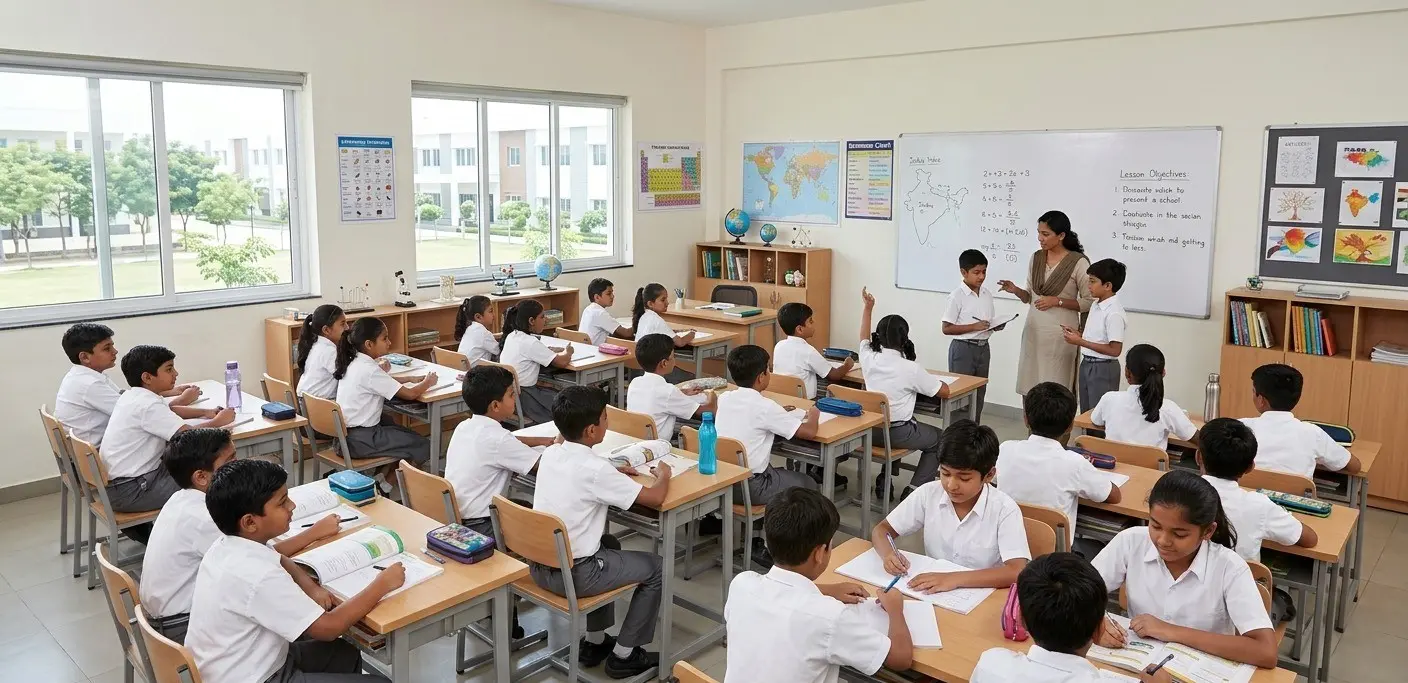
Look at student work, not only display boards. Ask whether children regularly discuss, experiment, write, present, collaborate and solve problems. A good classroom should show evidence that learning is happening rather than simply being described.
3. School culture feels healthy
Children spend a large part of their week at school. The tone of that environment matters. Parents should notice how staff speak to children, how students interact with one another, how discipline is handled and whether the campus feels respectful.
A child does not need a school that is completely pressure-free. They need a school where expectations are clear, mistakes can become learning opportunities and support is available when things become difficult.
4. Co-curricular activities are part of real school life
Sports, music, performing arts, clubs, technology and creative activities can help children discover interests that may never appear in a traditional examination. The important question is not whether a brochure lists these activities. Ask how frequently students participate and how many children actually get opportunities.
5. Facilities support learning
Labs, libraries, playgrounds, swimming pools, activity rooms and technology can be valuable when they are used properly. Parents should ask what students do in these spaces rather than judging a campus by how impressive it looks.
The CBSE affiliation requirements also set expectations around infrastructure, physical education, safety, teacher development, counselling and school information. These official requirements provide a useful baseline, although parents still need to evaluate how well a particular school puts them into practice.
A practical way to read the list of schools in Yelahanka
Search results often use phrases such as “best”, “top”, “leading” and “highest rated”. Those labels are useful for discovery, but they do not answer the question that matters most: would this school work for my child?
Current comparison pages also use different definitions of “top”. For example, one platform says its top-school list is based on popularity and user activity, while another describes a broader evaluation involving academics, infrastructure, extracurriculars, teacher quality and parent reviews. That means two websites can produce different top-ten lists without either one necessarily being fraudulent.
For example, UniApply’s Yelahanka school page states that its “Top” terminology is dynamic and linked to platform visits. Parents should therefore read the methodology before treating a ranking as an objective academic league table.
The smarter approach is to use rankings as a discovery tool, then verify the details that affect your child’s everyday life.
EuroSchool North Campus: a practical CBSE option for North Bengaluru families
For parents comparing best schools in Yelahanka, EuroSchool North Campus deserves close consideration when CBSE and balanced development are priorities. The official campus page states that it is affiliated with CBSE, serves Nursery to Grade 12, and is located at Survey No. 27, Srinivasa Pura Village, Yelahanka.
The campus is spread across 3.9 acres and lists science and computer laboratories, a library, reading rooms, playgrounds, smart-class technology and sports facilities. The published campus information also mentions football, tennis, skating, swimming and music-related facilities.
What makes this relevant to school selection is not the number of facilities. It is the range of experiences those facilities can support. Parents should ask how often children use them, whether participation is broad, and how activities fit alongside academic learning.
The wider EuroSchool learning approach describes LRPAX, which stands for Learn, Reinforce, Practice, Apply and Xperience. It also describes Balanced Schooling, the ASPIRE co-curricular ecosystem, ARGUS digital learning and wellbeing initiatives.
For a parent, those terms become useful only when translated into daily school life. Ask how a concept is introduced, how students practise it, how they apply it, how technology supports the process and what opportunities they have to experience learning beyond a worksheet.
The Yelahanka campus also publishes an admissions process involving counsellor interaction, prospectus review, document submission and a Child Skill Assessment Session. Parents should still confirm current grade availability and exact admission requirements before applying.
What facilities should parents expect from a strong Yelahanka school?
Facilities are easiest to evaluate when you connect each one to a learning purpose.
Facility | What parents should actually ask |
Classrooms | Are they spacious, well supervised and designed for active learning? |
Science and computer labs | How often do students use them, and what practical work do they do? |
Library | Can children access age-appropriate books regularly, or is it mainly a display space? |
Sports areas | How much scheduled activity do students receive, and how broad is participation? |
Creative spaces | Are music, art, theatre or similar activities part of regular school life? |
Digital learning | Does technology improve understanding, feedback and practice, or simply add screens? |
Safety systems | How are entry, dispersal, transport, emergencies and student supervision managed? |
CBSE, ICSE, Cambridge or IB: which curriculum should you choose?
There is no universally superior board. The right curriculum is the one that matches the child’s learning style, family mobility, future plans, preferred assessment pattern and the school that delivers it well.
CBSE
CBSE is a practical choice for many families who value national portability and a familiar academic structure. It is also widely available, which can help families who may relocate within India.
For Yelahanka families, CBSE can be particularly convenient because the area has a sizeable selection of schools following the board. Parents should still compare pedagogy, workload and school culture rather than assuming all CBSE schools feel alike.
ICSE and CISCE pathways
Families considering ICSE or CISCE may be attracted by broad academic exposure, language development and detailed subject treatment. The important point is to examine the actual school rather than treating the board as a guarantee of teaching quality.
Cambridge and IGCSE
These pathways may appeal to families seeking international curriculum exposure or planning for future study outside India. They can also differ significantly in assessment style and subject selection, so parents should understand the progression through secondary and senior years.
IB
IB can suit families seeking an internationally oriented approach with a strong emphasis on inquiry, reflection and broader learner development. It is important to consider whether the family genuinely wants that style of education and can sustain the associated fee commitment.
Fees: how to compare school costs without getting misled
School fees are one of the biggest sources of confusion in online school searches. A directory may show a monthly estimate, while the school may structure its charges annually or by term. The headline tuition can also exclude transport, books, uniforms, meals, activities or one-time admission charges.
Current Yelahanka comparison pages illustrate how wide the range can be. One current listing reports annual fee estimates from below ₹50,000 for some schools to several lakhs for premium options. Another shows monthly figures ranging from a few thousand rupees to substantially higher amounts. These numbers should be treated as indicative because the exact amount can depend on grade and fee components.
For a more reliable reference point, parents should review the school’s own published information. The EuroSchool Yelahanka campus page provides access to campus information and mandatory documents, including a fee card and affiliation-related documents.
- Ask for the complete first-year cost.
- Separate mandatory charges from optional charges.
- Confirm transport charges and routes.
- Ask whether books and uniforms are included.
- Check annual charges and technology or activity fees.
- Ask about fee increases for future academic years.
- Read the withdrawal and refund policy before making a large payment.
The most useful question is not “Which school is cheapest?” It is “What will we spend each year, what is included, and does the overall experience justify that commitment for our family?”
Eligibility criteria for 2026-27
Age eligibility varies by school and grade. Parents should never assume that a cut-off found on a third-party website is final. Check the school’s current admission communication and ask for the exact date used to calculate age.
At EuroSchool Yelahanka, the current official campus page states that children must be three years old for Nursery and six years old for Class 1, with age requirements increasing for higher grades. Parents should confirm the rule for their child’s specific admission year before applying.
- Birth certificate or proof of date of birth
- Previous school report cards where applicable
- Transfer certificate for relevant grades
- Passport-size photographs
- Address or identity documentation where requested
- Application and supporting forms
- Assessment or interaction where required
Admissions for 2026-27: what parents should do early
Admission planning is easier when treated as a project rather than a last-minute form submission. Some schools have fixed entry points, some accept applications subject to vacancies, and some use assessments or interactions depending on the grade.
The current EuroSchool Yelahanka admissions information describes a sequence that includes counsellor interaction, prospectus collection, document submission and a Child Skill Assessment Session. The exact process can change, so parents should confirm the latest requirements directly with the admissions team.
- Shortlist schools by board, location, budget and grade.
- Check official admission pages and current intake status.
- Confirm age criteria and whether the target grade has vacancies.
- Collect documents before the application window becomes busy.
- Visit the campus and ask questions about academics, safety and daily routines.
- Complete the assessment or interaction if required.
- Read the fee schedule and policies before accepting the seat.
Reviews: how to use parent feedback intelligently
Reviews can be extremely useful when read for patterns. They become less useful when treated as a simple five-star competition.
Look for recurring comments about teacher continuity, communication, homework, transport, discipline, safety, academic support and student wellbeing. A single angry or glowing review should not determine your decision.
A good review should lead to a question. If several parents mention communication delays, ask the admissions team how parent communication works. If families praise sports, ask how many students participate and how often. If parents mention heavy homework, ask what the typical weekly workload looks like for your child’s grade.
During your campus visit, compare what you see with what you read. That is where online research becomes real-world decision-making.
What to look for during a campus visit
Classroom atmosphere
Do classrooms look like places where children think, discuss and create? Look for student work, books, projects and practical learning materials. Notice whether the environment feels active but orderly.
Teacher interaction
Ask how teachers identify children who need extra help. Also ask how the school stretches children who are already performing strongly. A good support system should not be designed only for one end of the learning spectrum.
Student confidence
Watch how students speak to adults and one another. Children do not need to look perfectly rehearsed. Natural confidence, curiosity and comfort can be more informative than a polished performance.
Safety and supervision
Ask about visitor management, transport safety, emergency procedures, medical support, dispersal and supervision. These are everyday systems, not brochure features.
Co-curricular participation
Ask whether every child gets meaningful opportunities in sport, music, art, clubs or other activities. Participation should not be reserved only for a small group of already talented students.
Common mistakes parents make while comparing schools in Yelahanka
Mistake 1: Choosing the loudest brand
Visibility is not the same as fit. A school can be highly searched and still not suit your child’s temperament or your family’s routine.
Mistake 2: Choosing the board before understanding the child
The board should support your educational goals. Do not select it simply because another family recommends it.
Mistake 3: Comparing only the first-year fee
Schooling is a multi-year commitment. Calculate the total annual cost and think about how it may change as the child moves into higher grades.
Mistake 4: Ignoring commute
A long daily journey can affect sleep, homework, sports, family time and mood. A slightly closer school can sometimes create a much better overall school day.
Mistake 5: Applying too late
Fixed entry points and vacancy-based admissions can make late applications difficult. Track deadlines early.
Mistake 6: Treating facilities as proof of teaching quality
A beautiful laboratory does not tell you how often students use it. Ask what happens inside the facility.
Mistake 7: Choosing for marks alone
Academic performance matters, but children also need communication, independence, confidence, relationships, physical activity and emotional support.
Mistake 8: Forgetting the next five years
A school that works beautifully for the current grade should also be assessed for middle school, secondary school and senior-school continuity.
What does future-ready schooling actually mean?
“Future-ready” is now common school language, but parents should ask what it means in practice. A child does not become future-ready simply because a classroom has a smart screen.
Future-ready learning should build strong foundations while helping children communicate, collaborate, solve problems, adapt to new situations and use technology thoughtfully. It should also leave room for curiosity and creativity.
The Government of India’s National Education Policy 2020 places strong emphasis on holistic development, foundational learning, skills and a broader view of education. Parents can use that policy direction as a useful reference when evaluating how a school describes its learning approach.
EuroSchool’s published approach also reflects this broader direction through its emphasis on Balanced Schooling, digital learning, co-curricular programmes and wellbeing. The value for parents is not in the terminology itself, but in asking how those ideas appear in the child’s timetable and classroom experience.
A simple shortlist method for parents
If your initial search produces dozens of names, do not visit every school. Narrow the field in stages.
- Choose the curriculum direction.
- Set a comfortable long-term budget.
- Draw a realistic commute radius.
- Check grade availability and age eligibility.
- Read enough reviews to identify recurring questions.
- Visit three to five serious options.
- Score each school on teaching, culture, safety, facilities, activities, commute and value.
This approach is far more useful than saving twenty school websites and hoping one eventually feels right.
A screenshot-worthy school comparison checklist
What to compare | Ask this | Why it matters |
Board | Which board and exact grade pathway does this campus offer? | Avoids choosing the wrong curriculum or assuming all branches are identical. |
Teaching | How do teachers support different learners? | Shows whether learning is genuinely child-centred. |
Fees | What is the complete annual cost? | Prevents unexpected charges later. |
Commute | How long will the daily journey realistically take? | Protects sleep, family time and routine. |
Activities | How often can every child participate? | Separates real opportunities from brochure claims. |
Safety | What happens at arrival, dispersal and during emergencies? | Daily safety systems matter more than general assurances. |
Admissions | What are the age cut-off, entry points and documents? | Reduces last-minute admission stress. |
Future | What happens as the child moves into higher grades? | Supports long-term continuity. |
How many schools should you shortlist?
For most families, three to five serious options are enough. A shortlist that is too small can leave you with no practical alternative if admissions do not work out. A shortlist that is too large makes every visit feel interchangeable.
A sensible structure is one preferred school, two strong alternatives and one or two options that are more conservative on budget or commute. The goal is not to apply everywhere. It is to create choice without creating chaos.
Why EuroSchool can be a strong consideration for North Bengaluru families
If your priority is a CBSE school that combines academics with co-curricular exposure and modern infrastructure, EuroSchool Yelahanka North Campus is worth a serious visit.
The official campus information covers Nursery through Grade 12, CBSE affiliation, laboratories, library resources, sports spaces, smart-class technology and admissions support. The wider EuroSchool model adds Balanced Schooling, LRPAX, ARGUS digital learning, ASPIRE programmes and wellbeing initiatives.
Its location can also work for families across parts of North Bengaluru, including Yelahanka, Jakkur and nearby areas. But parents should make the commute test themselves. A school that looks perfect on paper can be the wrong choice if the daily journey is exhausting.
The official EuroSchool campus information also makes several school documents accessible, allowing parents to verify important information rather than relying only on promotional summaries.
FAQs
Which are the best schools in Yelahanka for 2026-27?
There is no single school that is objectively best for every child. Current 2026-27 comparison platforms surface different lists because they use different methodologies, geographic boundaries and popularity signals. Parents should shortlist schools according to board, budget, commute, teaching quality, safety, student support and long-term fit.
What are the top 10 schools in Yelahanka?
Search platforms publish different versions of the top 10 depending on their ranking method. One platform may prioritise visits or popularity, while another may combine reviews, facilities and academic signals. Rather than treating one top-ten list as final, use several sources to discover schools and then verify the details directly.
How many schools are there in Yelahanka?
The number depends on how the platform defines Yelahanka and nearby areas. Current 2026 sources show substantially different totals, including 44, 56 and 72 listings. This variation is another reason to focus on the schools that are geographically and academically relevant to your family.
What is the fee structure of schools in Yelahanka?
Fees vary considerably by board, school type, grade and facilities. Current directories show a wide range from relatively affordable schools to premium institutions with several-lakh annual costs. Parents should request the latest official fee schedule and include transport, books, uniforms, activities and one-time charges in the calculation.
What are the age criteria for EuroSchool Yelahanka?
The current official EuroSchool Yelahanka campus page states that children must be three years old for Nursery and six years old for Class 1, with age requirements increasing for higher grades. Parents should confirm the applicable cut-off for the specific academic year and grade before applying.
Which board is best for a child in Yelahanka?
There is no universally best board. CBSE can be practical for families seeking national portability, while ICSE/CISCE, Cambridge, IGCSE and IB may suit different academic preferences and future plans. The school’s teaching quality and fit with the child matter as much as the board label.
How should parents compare school reviews?
Look for patterns rather than star ratings. Recurring comments about teaching, communication, transport, homework, discipline and wellbeing are more useful than one unusually positive or negative review. Then test those observations during a campus visit.
How many schools should parents visit?
Three to five serious options are usually enough for a meaningful comparison. Visit schools that already match your board, budget, commute and grade requirements rather than touring every school that appears in a search result.
Does EuroSchool Yelahanka offer CBSE from Nursery to Grade 12?
Yes. The current official campus page states that EuroSchool Yelahanka follows the CBSE curriculum from Nursery to Grade 12. Parents should still confirm current grade availability and admissions status for the required academic year.
Does EuroSchool Yelahanka provide transport?
The current campus information states that EuroSchool offers transportation services with GPS-equipped buses. Parents should confirm routes, pickup points, timings and current transport charges for their location.
Conclusion
Choosing among the schools in Yelahanka is not about finding the loudest name or copying somebody else’s top-ten list. It is about making a decision that still feels sensible after the excitement of an admission brochure has passed.
Start with the board. Then consider the child. Then consider the commute, the fee commitment, the teaching approach, the school culture and the opportunities beyond academics. Finally, look at whether the school can support your child as they move from one stage of education to the next.
Yelahanka gives parents genuine choice, and that is both its advantage and its challenge. The variety of CBSE, ICSE/CISCE, Cambridge, IGCSE and IB pathways means families can find a school aligned with very different goals. It also means that labels such as “best”, “top” and “international” need to be examined rather than accepted at face value.
For families looking for a balanced CBSE experience in North Bengaluru, EuroSchool Yelahanka North Campus deserves a serious look because its published offer combines CBSE schooling with modern facilities, co-curricular opportunities, digital learning and a broader focus on student development.
The final test is simple. Can your child travel to the school comfortably? Can your family sustain the fee? Do teachers seem capable and approachable? Does the child feel safe and curious? Can the school support both academic progress and personal growth? If the answer is yes, you may have found a much better match than any generic ranking could have given you.
A school decision should leave parents with clarity, not anxiety. Take the time to compare carefully, verify important information at source, and choose the environment in which your child has the strongest chance to learn well, grow confidently and enjoy the years ahead.