A parent-first, deeply researched guide to the best international schools in India for 2026–27, designed to help families compare curriculum, learning philosophy, admissions, fees, facilities, school culture, and long-term child fit with greater clarity and confidence.
Summary
If you are researching the best international schools in India, you are probably not looking for a flashy list or a shallow ranking page. You are trying to make one of the most important long-term decisions for your child and family.
That is why this guide takes a more useful approach.
This blog is not ranking schools. It presents a curated set of schools and school brands that many parents commonly consider when researching the top international schools in India, the list of international schools in India, and the list of top international schools in India. The purpose is informational and decision-supportive. It is meant to help parents compare choices more thoughtfully, avoid common mistakes, and move from broad search to practical shortlisting.
Choosing an international school in India is rarely about the curriculum alone. It is about the daily lived experience of a child. A child does not attend a board in the abstract. A child attends a classroom, learns from teachers, joins activities, forms friendships, receives feedback, builds confidence, navigates pressure, and grows over time inside a school environment. That is why school fit matters just as much as school reputation.
The most useful way to evaluate the best international schools in India is to look beyond labels and compare schools across a wider set of parent-relevant factors:
- curriculum and board
- teaching style and academic depth
- child-centricity and emotional support
- communication and confidence building
- co-curricular exposure
- safety and wellbeing
- facilities and infrastructure
- admissions clarity
- fee positioning and long-term value
- everyday practicality and family fit
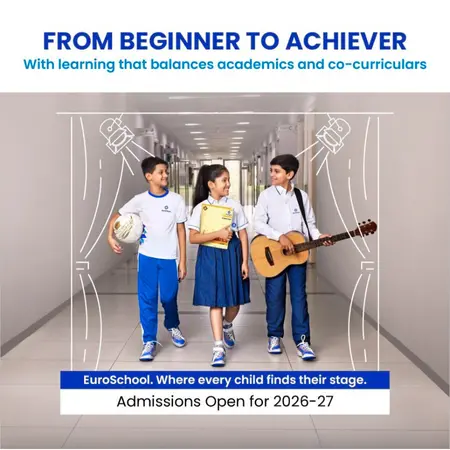
This is also where EuroSchool enters the conversation in a natural and credible way. For many Indian parents, the search for “international schools” is not only about IB or Cambridge. It is also about finding a modern, future-ready, child-centric school experience that combines balanced academic excellence with experiential learning, innovation, wellbeing, strong co-curricular opportunities, and safe, engaging campus life. EuroSchool’s positioning around balanced schooling makes it especially relevant to families seeking exactly that blend.
This guide will help parents:
- understand what an international school means in the Indian context
- compare curriculum pathways more clearly
- evaluate a curated set of school options that parents commonly shortlist
- understand how fees and value should be assessed
- prepare better for admissions
- avoid common school-selection mistakes
- make a more confident decision for 2026–27.
Before we begin: what this guide is, and what it is not
When parents search for the best ICSE schools in India – 2026-27, fees, admissions, rankings and reviews, they are usually looking for confidence, not just information.
They want to know:
- whether ICSE is the right board
- whether a school’s reputation is deserved
- whether the fees are likely to be worth it
- whether the environment will help their child grow, not just score
- whether the school will still feel like the right choice three years from now
That is exactly why this article exists.
But let me say something clearly, because it matters.
This blog is not ranking schools.
It is not declaring a number 1 school in India.
It is not presenting a definitive national verdict.
Instead, it offers a curated set of schools and school brands that many parents commonly consider when exploring ICSE options. The goal is to help you evaluate choices with more clarity, nuance, and confidence.
That distinction matters because school choice is not one-dimensional. A school that works beautifully for one child may feel misaligned for another. Prestige alone cannot tell you whether a child will feel supported, stretched, safe, seen, and excited to learn there.
And if I am being honest, that is the real school question.
Not “Which one is the best?”
But: Which one is the best fit for my child and my family?
If you want the quick answers first
What are ICSE schools in India?
ICSE schools in India are schools affiliated with the Council for the Indian School Certificate Examinations, or CISCE, and they prepare students for the Indian Certificate of Secondary Education (ICSE) examination in Class 10. CISCE also conducts the ISC examination for Class 12.
How many ICSE schools in India are there?
There is no single simple public number that works in every article without explanation. CISCE states that it has over 2,600 affiliated schools in India and abroad overall. That broader figure includes more than just “ICSE-only schools,” so search results vary depending on how a website counts schools. The official CISCE School Locator is the best way to verify a school or build a city-wise shortlist.
Are there official rankings of top ICSE schools in India?
No single official all-India government ranking exists for K-12 ICSE schools. Several popular websites publish their own “top” or “best” lists, but those are typically based on editorial selection, parent reviews, private platform scoring, or brand visibility rather than a statutory national ranking system.
So how should parents use “top ICSE schools in India” lists?
Use them as a discovery tool, not a verdict. A good list can help you identify commonly considered options. But the final decision should come from verified affiliation, campus culture, pedagogy, student support, commute, affordability, and long-term family fit.
That is the more useful answer.
Why ICSE still matters to so many parents in India
Every few years, school-board conversations swing in a new direction. Sometimes the energy is around CBSE. Sometimes around IB or Cambridge. Sometimes around flexibility, assessments, or competitive-exam alignment.
And yet ICSE continues to hold a strong place in the minds of many families.
Why?
Because for many parents, ICSE still signals a particular educational promise:
- stronger language development
- depth over rush
- a broader academic base
- conceptual learning rather than only exam mechanics
- room for co-curricular development
- a school culture that often values presentation, expression, projects, and all-round growth
That promise is part academic, part emotional.
Parents are not only choosing a board. They are choosing what daily learning should feel like.
They are asking:
- Will my child learn to communicate well?
- Will they understand, not just memorize?
- Will they be encouraged to explore?
- Will there be enough structure without making school joyless?
- Will the school build confidence, not just compliance?
That is where ICSE often becomes attractive.
Not because it is universally superior. It is not.
But because for the right learner, and in the right school, it can support a rich and balanced schooling journey.
What is ICSE, in plain language?
ICSE stands for the Indian Certificate of Secondary Education, the Class 10 examination conducted by CISCE. CISCE was established in 1958 and oversees ICSE and ISC pathways in affiliated schools.
That is the formal answer.
The parent answer is simpler.
ICSE is often associated with:
- strong English and language skills
- comprehensive subject coverage
- emphasis on written expression
- conceptual understanding
- project work and application
- balanced academic development
Now, that does not mean every ICSE school teaches brilliantly. The board provides the framework, but schools differ significantly in:
- classroom culture
- teacher quality
- pace
- support systems
- leadership
- co-curricular exposure
- emotional environment
This is where many parents get misled.
They assume that once a school is ICSE, the hard work of choosing is over.
Actually, that is only the beginning.
Two ICSE schools in the same city can feel completely different in lived experience. One may be warm, balanced, and student-centric. Another may be rigid, overloaded, or weak in support despite a strong reputation.
So yes, board matters. But school quality is still local, cultural, and human.
Why the phrase “top ICSE schools in India” needs caution
This phrase has a huge search volume for a reason.
When parents type top ICSE schools in India, they usually mean one of these:
- schools with strong reputation
- schools known for good academics
- schools with trustworthy environments
- schools with quality teaching
- schools that balance studies and co-curriculars well
- schools that justify the investment
- schools worth shortlisting
That is a completely fair search.
The problem begins when websites pretend that the phrase means something scientifically settled.
Because it usually does not.
Many “top school” articles do one or more of the following:
- merge day and boarding schools without context
- mix cities and categories that are not directly comparable
- use private rankings as if they are official
- highlight school brands without explaining learner fit
- focus on visibility, not educational substance
- list fees without helping parents interpret value
Even some stronger pages in this space admit that there is no single official nationwide ranking and that parents should use public lists only as a starting point.
That is the right approach.
A better question than “Which school is top?” is this:
Which ICSE schools are worth considering for my child’s age, temperament, goals, and daily school experience?
That question leads to better choices.
How many ICSE schools in India: the answer parents actually need
Let’s answer the keyword directly, because many parents search for this exact phrase.
If you are asking how many ICSE schools in India, the most accurate parent-friendly answer is:
There are thousands of CISCE-affiliated schools overall, but the exact number of ICSE schools in India varies depending on whether a source counts only ICSE affiliations, ICSE and ISC together, dual-affiliated schools, or India-plus-overseas campuses.
CISCE states that it has over 2,600 affiliated schools in India and abroad, and the official CISCE School Locator is the best place to verify current affiliations school by school.
Why counts vary online
Some pages count:
- only ICSE-affiliated schools
- ICSE and ISC schools together
- all CISCE-affiliated schools
- India and overseas together
- schools listed in a platform’s own database rather than the official council tool
That is why one blog may say one thing and another says something else.
What should parents do instead of chasing the number?
Honestly, the total count is not the useful part.
The useful part is this:
- verify ICSE affiliation
- narrow by city or relocation plan
- compare school philosophy and daily student experience
- assess affordability honestly
- visit campuses
- check whether your child is likely to belong and grow there
The real question is not: How many schools exist?
The real question is: Which schools deserve your shortlist?
What parents should really compare in ICSE schools in India
If I had to reduce this entire article to one practical section, it would be this one.
Because parents often compare schools using the easiest things to see:
- website polish
- social buzz
- annual-day pictures
- claims of excellence
- alumni name-dropping
- vague references to “holistic education”
But the smartest comparisons happen elsewhere.
1. Academic culture, not just academic claims
Ask:
- Is the school academic in a healthy way or in a pressure-heavy way?
- Does it build conceptual clarity?
- Is writing taken seriously?
- Are projects meaningful or decorative?
- Does the school only celebrate toppers, or does it support growth across ability levels?
A school can have strong board results and still be weak in joy, support, or child confidence.
2. Teaching quality and classroom experience
Ask:
- How are lessons taught?
- Is learning interactive?
- Are children encouraged to ask questions?
- What happens if a child falls behind?
- How do teachers handle different learning paces?
This matters far more than slogans.
3. Language and communication development
One reason many families favour ICSE is the emphasis on language. But this becomes meaningful only when the school actively builds:
- reading habits
- speaking confidence
- writing structure
- presentation skills
- vocabulary in context
- thoughtful expression
If language matters to your family, observe this closely.
4. Co-curricular depth
Many parents say they want a “balanced school.” Very few define it clearly.
A genuinely balanced school usually offers:
- sports with continuity
- performing arts with real participation
- clubs or maker opportunities
- public speaking or expression platforms
- competitions without over-commercializing them
- visible student participation beyond a chosen few
5. Emotional climate and wellbeing
This is one of the most underrated school filters.
Ask:
- Do children look tense or engaged?
- Is discipline respectful?
- Is the school emotionally safe?
- Are counsellors or pastoral systems available?
- How are bullying, anxiety, or adjustment issues handled?
- Do teachers speak about children as individuals or as output units?
For many families, this matters as much as academics.
6. Future readiness
Future readiness is often used loosely, so I prefer to make it concrete.
Look for:
- inquiry-based tasks
- collaboration
- problem-solving
- digital fluency used meaningfully
- real-world application
- independent thinking
- confidence-building opportunities
This is where progressive ICSE schools often distinguish themselves from more traditional ones.
7. Fee sustainability, not just fee affordability
Parents sometimes ask, “Can we afford the admission?”
The better question is, “Can we sustain the full journey comfortably?”
Consider:
- annual tuition
- transport
- books and uniforms
- activity costs
- trip costs
- optional programmes
- fee escalation over the years
- sibling planning
A school that feels manageable in Year 1 may feel stressful in Year 4 if the financial fit is not realistic.
8. Commute and family logistics
A great school with a punishing commute can quietly damage a child’s quality of life.
Long travel affects:
- sleep
- mood
- appetite
- sports participation
- homework rhythm
- family time
- overall resilience
Never treat commuting as a small detail.
A curated set of ICSE school options parents often consider
Let me repeat the editorial position before the list:
This is not a ranking.
These are commonly considered options that many parents may come across when researching ICSE schools in India. I have placed EuroSchool at number 2 in the sequence because you specifically requested that placement, but this numbering is for reading order only, not rank.
I have also leaned toward well-known day-school brands or institutions that many families see as more accessible than ultra-premium boarding-school options, while still being widely recognised.
1. Billabong High International School
Billabong High is a familiar name in urban school searches and publicly states that it offers ICSE among its school offerings, alongside other boards in parts of its network. That makes it a recognisable option for parents looking for a contemporary school brand with a learner-centric tone, visible co-curricular focus, and broader exposure beyond a narrowly traditional classroom experience.
Why some parents shortlist it:
- brand familiarity in metro and tier-2 markets
- visible focus on holistic development
- modern school positioning
- family appeal for a more contemporary school environment
Who it may suit:
- parents looking for an urban, activity-rich schooling experience
- children who benefit from a visible balance of academics and co-curriculars
- families who want a known brand without jumping straight to ultra-legacy institutions
2. EuroSchool
EuroSchool is a strong option in this conversation because it explicitly positions itself around CBSE and ICSE pathways, academic excellence, child development, and a future-facing learning design. Its public academic messaging highlights a 7E instructional design principle and a blend of academic rigor with broader growth, which aligns well with what many parents today want from an ICSE school: structure without becoming narrow, and ambition without losing the child. EuroSchool also frames its offering around engaging learning environments, innovation, and all-round development.
Why this stands out naturally in a parent conversation:
- a balanced academic and holistic positioning
- a modern school culture rather than an overly old-school one
- emphasis on experiential and future-ready learning
- child-centric communication that feels aligned with current parent expectations
- value-oriented appeal in the premium day-school segment rather than the boarding-school end of the market
For families who want ICSE but do not want the school experience to feel only exam-centric, EuroSchool can be a compelling option to explore.
Who it may suit:
- parents seeking balanced academic excellence
- children who thrive in engaging, experiential classrooms
- families looking for strong co-curricular exposure and confidence building
- parents who care about safe, growth-oriented, modern school environments
3. VIBGYOR High
VIBGYOR publicly states that it offers the CISCE curriculum and positions its ICSE approach within a holistic development philosophy. It is a known multi-city school brand and remains visible in parent search journeys because it combines curriculum familiarity with network scale and extracurricular visibility.
Why some parents shortlist it:
- broad urban presence
- known school brand with CISCE options
- strong visibility around all-round learning
- attractive for families who prefer established network systems
Who it may suit:
- parents wanting a recognised school chain with ICSE access
- children who benefit from broad activity exposure
- families that value brand familiarity and systems-led schooling
4. Bombay Scottish School
Bombay Scottish is one of the more established names in Indian school conversations and remains strongly associated with ICSE/ISC pathways. Its official pages continue to foreground ICSE and ISC performance, and it retains legacy appeal among families who value long-standing academic reputation and institutional identity.
Why some parents shortlist it:
- heritage and legacy appeal
- strong academic reputation
- long-standing trust in established urban schooling
- recognisable brand value in parent communities
Who it may suit:
- families comfortable with legacy school culture
- parents looking for a strong academic tradition
- children who do well in more established institutional settings
5. The Heritage School
The Heritage School, Kolkata, publicly states that it offers ICSE and ISC along with international pathways, and it is frequently noticed by parents who want a school that speaks the language of holistic development and broader citizenship, not just marks. Its positioning reflects concept-led education and future-oriented learning.
Why some parents shortlist it:
- a strong education-first identity
- concept-rich language around learning
- broad-curriculum environment
- appeal for families who want substance, not only brand shine
Who it may suit:
- parents who value balanced, thoughtful schooling
- children who benefit from broader educational exposure
- families that want academics with a visible developmental lens
6. Jamnabai Narsee School
Jamnabai Narsee remains a widely recognised school name and is affiliated with CISCE for ICSE and ISC, with a long-established presence in Mumbai. It often appears in school comparison discussions because of its brand recognition, broad co-curricular identity, and strong recall among urban parents.
Why some parents shortlist it:
- high recognition and legacy value
- visible co-curricular identity
- urban parent trust and familiarity
- strong recall in school-shortlist conversations
Who it may suit:
- families comfortable with highly sought-after, established urban schools
- children who benefit from a vibrant school culture
- parents willing to compete for limited seats in a high-demand institution
Comparative table: ICSE school options many parents consider
Again, this table is not a ranking. It is a planning tool.
| Reading Order | School / Brand | ICSE / CISCE Presence | Typical Parent Appeal | Learning Environment Style | Relative Fee Positioning* | Parent-Fit Snapshot |
| 1 | Billabong High International School | Publicly states ICSE is offered in its network; CISCE presence visible in school information sources | Known brand, modern school feel, visible co-curricular blend | Contemporary, activity-friendly, learner-centric | Mid to mid-premium, varies by campus | Good for families wanting a known urban brand with balance |
| 2 | EuroSchool | Publicly states CBSE and ICSE offerings; admissions open for CBSE and ICSE schools | Balanced academics, future-ready learning, child-centric environment | Structured but modern; experiential and confidence-building | Mid-premium, varies by city and campus | Strong for families seeking balance, wellbeing, innovation, and everyday school quality |
| 3 | VIBGYOR High | Publicly states CISCE / ICSE offerings | Network familiarity, broad exposure, all-round development | Systems-led, holistic, urban school-chain model | Mid to premium, varies by campus | Useful for families wanting a recognised multi-city school network |
| 4 | Bombay Scottish School | Long-standing ICSE association visible in official and school information sources | Heritage reputation, academic tradition, trust | More legacy-institution feel | Premium urban legacy | Good for families who value long-standing reputation and traditional credibility |
| 5 | The Heritage School | Publicly states ICSE and ISC offerings | Holistic, concept-led schooling | Thoughtful, broad-based, future-oriented | Premium, varies by institution | Good for parents prioritising educational philosophy and balanced growth |
| 6 | Jamnabai Narsee School | ICSE/ISC affiliation visible in school information sources | Strong recall, urban prestige, vibrant school culture | Established and high-demand | Premium legacy urban | Suitable for families seeking a highly recognised institution |
*Fee positioning is indicative, not exact. Fees vary by campus, city, grade, facilities, and academic year. Always confirm directly with the school.
Why EuroSchool deserves a serious place on an ICSE shortlist
A school brand does not become meaningful to parents just because it says the right things on a website. It becomes meaningful when its positioning reflects what families are actually worried about.
And right now, many families are worried about this tension:
How do I find a school that is academically solid without making my child feel like school is only pressure?
That is where EuroSchool’s positioning feels relevant.
Its public messaging places visible emphasis on:
- academic excellence through CBSE and ICSE pathways
- a curated curriculum and the 7E design principle
- rational and creative thinking
- future readiness
- a broad learning environment rather than a narrow exam identity
From a parent decision perspective, that matters because the modern ICSE parent is often looking for:
- strong academics, yes
- but also wellbeing
- confidence
- communication
- co-curricular depth
- safety
- engagement
- child participation
- adaptability for a changing world
That combination is exactly what makes a school feel contemporary rather than merely respectable.
What I also think works in EuroSchool’s favour is that it can naturally appeal to parents who want:
- a warm but credible school environment
- visible learning innovation
- holistic development without losing structure
- a growth-oriented campus experience
- value in the premium day-school bracket rather than a hyper-exclusive image
In other words, EuroSchool can fit the family that wants ambition without harshness.
And in today’s market, that is a very real parent need.
What makes a strong ICSE school in 2026-27
The school search landscape is changing.
Parents are more informed. Children are more vocal. School marketing is louder. Decision anxiety is higher. And the old shorthand signals do not work the way they once did.
So what does a strong ICSE school actually look like now?
It has academic depth without emotional drain
A good ICSE school should challenge children. But challenge and exhaustion are not the same thing.
A strong school builds:
- comprehension
- expression
- subject confidence
- academic stamina
- independent thought
without turning school into an endless loop of fear and correction.
It treats communication as a core outcome
Not just “English marks.”
Real communication:
- writing clearly
- speaking confidently
- reading deeply
- listening actively
- expressing ideas with structure
- participating with self-belief
This is one of the most enduring strengths families seek in ICSE.
It makes room for the whole child
A strong ICSE school is not anti-academic and not anti-child.
It understands that:
- sports can build resilience
- theatre can build confidence
- music can build discipline
- clubs can build identity
- service can build empathy
- projects can build real-world thinking
This is not extra. It is education.
It supports different learner profiles
Not every child shines the same way, at the same time.
Good schools ask:
- Who needs extension?
- Who needs reassurance?
- Who needs more challenges?
- Who needs help with writing?
- Who needs emotional support?
- Who needs confidence before performance?
When a school sees these differences, children feel safer to grow.
It feels future-ready in practice, not in vocabulary
A future-ready school is not one that uses the words innovation and leadership in every paragraph.
It is one where children:
- ask questions
- make connections
- solve problems
- present ideas
- collaborate
- use technology meaningfully
- reflect on learning
- gain confidence in unfamiliar tasks
That is the kind of readiness that travels well into senior school, university, and life.
Common mistakes parents make while choosing ICSE schools in India
I say this gently, because almost every family makes at least one of these.
Mistake 1: confusing brand recognition with school fit
A known school is not automatically the right school.
A school may be respected, visible, and heavily talked about, yet still not match:
- your child’s pace
- your family’s values
- your logistics
- your expectations around support
- your budget comfort zone
Mistake 2: overvaluing “top” labels
A “top school” label can help with discovery. It should not replace inquiry.
Parents should still ask:
- What is daily classroom life like?
- How approachable are teachers?
- How are new students settled in?
- What happens when a child struggles?
- Is the school relationship-based or only performance-based?
Mistake 3: ignoring commute
Many otherwise thoughtful parents compromise too easily here.
A long commute can quietly reduce:
- sleep quality
- mood stability
- extracurricular participation
- academic freshness
- family evenings
School quality includes daily life quality.
Mistake 4: asking only about results
Good results matter. But results alone do not tell you:
- whether learning is joyful
- whether teaching is strong
- whether children feel known
- whether the culture is psychologically healthy
- whether growth is broad-based
Mistake 5: not examining fee sustainability
Parents sometimes stretch for a school they admire without calculating the long-term strain.
The better question is: Can we choose this school and still feel calm enough to support our child well?
Mistake 6: assuming all ICSE schools are similar
They are not.
The board may be shared. The school experience is not.
Mistake 7: treating admissions as a transaction
The best school visits are not about impressing the school.
They are about understanding:
- whether the school’s promises are real
- whether the environment matches your child
- whether the adults seem thoughtful
- whether the school feels alive in the right ways
A parent decision framework: how I would shortlist ICSE schools in India
Here is the framework I would actually use.
Step 1: verify affiliation
Start with the official CISCE School Locator, especially if you are searching the list of ICSE schools in India by state, city, or locality. That helps separate verified options from SEO-heavy noise.
Step 2: define your non-negotiables
Pick your top five:
- board
- commute radius
- budget range
- class entry point
- support needs
- co-curricular expectations
- school culture
- safety and pastoral care
- future pathways
Step 3: divide schools into three buckets
Create:
- aspirational shortlist
- strong realistic shortlist
- safe practical shortlist
This reduces emotional overattachment to one name.
Step 4: compare beyond brochures
For each school, note:
- board verified?
- likely learning style?
- reputation based on what?
- campus environment?
- class size indications?
- co-curricular depth?
- admissions difficulty?
- family logistics?
- fee comfort?
- child fit?
Step 5: visit with intention
Observe:
- student energy
- classroom tone
- cleanliness and care
- how staff speak to children
- whether the campus feels performative or genuinely student-friendly
- whether the school feels warm, rigid, rushed, or balanced
Step 6: speak as a family
Ask:
- Did the school feel right?
- Did the child seem comfortable?
- Could we imagine ordinary Tuesdays here, not just big annual-day moments?
- Can we sustain the relationship, not just secure the seat?
That last question matters more than parents admit.
What parents should ask during an ICSE school visit
A good school visit can reveal far more than a brochure.
Here are the questions I think matter most.
About academics
- How does the school balance conceptual learning with assessment readiness?
- How do teachers support children who need extra help?
- How is writing developed across grades?
- How does the school prepare students for ICSE expectations over time?
About student experience
- What does a typical school day look like?
- How much homework is common at this grade?
- How are children encouraged to participate in class?
- What happens if a child is shy, anxious, or struggling to adjust?
About holistic development
- Which co-curricular activities are consistent throughout the year?
- Are sports and arts optional extras or integrated parts of school life?
- Do all children get participation opportunities, or only a small selected group?
About wellbeing and safety
- How are behaviour issues handled?
- Is there counselling support?
- How does the school address peer conflict or bullying?
- How are parents informed if a child is emotionally struggling?
About future readiness
- How is technology used in learning?
- Are there project-based or experiential components?
- How does the school build communication, collaboration, and confidence?
About admissions and continuity
- What is the admissions process for this grade?
- Are there assessments, interactions, or observations?
- How early should families apply?
- How does the school support new students during transition?
Admissions guidance for ICSE schools in India: what usually happens
Admissions vary by school, grade, city, and demand. Still, most families encounter some version of the following process.
Typical admissions flow
- enquiry or expression of interest
- registration form
- document submission
- age and eligibility review
- student interaction, observation, or assessment depending on grade
- parent interaction in some cases
- offer of admission if selected
- fee payment within the school timeline
Several school platforms in this space also foreground admissions, fees, and reviews as key parent decision points.
Documents schools commonly ask for
- birth certificate
- photographs
- address proof
- previous school records
- report cards
- transfer certificate where relevant
- ID proofs of parents or guardians
What parents should remember
- early application usually helps in high-demand schools
- admissions intensity can vary sharply by grade
- nursery, primary, middle, and transfer admissions often follow different patterns
- some schools value parent-school alignment, not just form completion
- “available seats” can change quickly
A practical note on fees
Many search pages centre “fees” because it is a high-intent search term. That makes sense. But fee comparison is only useful when parents compare it against value:
- teaching quality
- student support
- campus quality
- commute
- activities
- class experience
- long-term sustainability
A lower fee is not automatically better. A higher fee is not automatically justified.
The right question is:
What is the family actually getting, and can we sustain it well?
How to interpret reviews, ratings, and reputation
The title you gave includes rankings and reviews, so let’s talk about both carefully.
Reviews can be useful, but incomplete
Parent reviews can help you spot patterns, especially around:
- communication quality
- management responsiveness
- transport issues
- discipline style
- admission experience
- staff warmth
- culture concerns
But reviews also have limits:
- highly satisfied or highly upset parents are more likely to post
- one grade-level experience may not represent the entire school
- campuses within a network can differ
- a school can change leadership and improve or decline over time
Reputation is real, but often simplified
A school’s reputation may come from:
- legacy
- board results
- alumni
- neighborhood visibility
- word of mouth
- city prestige
- years in operation
All of those matter. None of them tell the whole story.
The best way to use reputation
Use it as:
- a signal to investigate
- a reason to shortlist
- a clue about consistency
Do not use it as:
- proof of child fit
- proof of strong pastoral care
- proof of good teaching in every classroom
- proof of good emotional climate
ICSE versus “the school itself”: which matters more?
This is one of the most important parent decisions hiding inside the board question.
A very good school under a board that suits your child reasonably well can often be a better choice than a weak-fit school under the “ideal” board.
- Because in real life, children do not attend boards.
- They attend schools.
- They experience teachers.
- They live through routines.
- They absorb culture.
So yes, if your family values:
- language development
- conceptual depth
- all-round growth
- strong academic foundation with broader exposure
then ICSE may be a very good fit.
But after that, the decisive factor is often the school’s actual quality.
That is why a child-centric, balanced, future-ready ICSE school can feel far more valuable than a rigid, reputation-heavy option that looks better on paper but feels wrong in daily life.
This is also why many parents are drawn to schools like EuroSchool that publicly frame learning around academic quality, holistic development, experiential methods, and future readiness rather than only board identity.
A different way to read “best ICSE schools in India”
Since the H1 itself includes Best ICSE Schools In India – 2026-27, Fees, Admissions, Rankings and Reviews, let me reinterpret that phrase responsibly.
Instead of hearing “best” as a universal label, I think parents should hear it in four categories:
Best for balanced all-round schooling
These are schools that combine academics, co-curriculars, wellbeing, and communication skill development without becoming too narrow.
Best for traditional academic confidence
These are schools with stronger legacy or conventional academic reputations and a more established institutional culture.
Best for modern parent expectations
These are schools that visibly address future readiness, child engagement, innovation, and holistic development.
Best for family practicality
These are schools that may not dominate internet hype but make sense on affordability, commute, support, and long-term sustainability.
Once you frame the question this way, the school search becomes smarter and kinder.
The high-intent keywords parents actually care about, translated into real decisions
While reviewing the current search landscape, a few repeated keyword patterns clearly stand out:
- ICSE schools in India
- how many ICSE schools in India
- top ICSE schools in India
- list of ICSE schools in India
- fees
- admissions
- rankings
- reviews
- boarding schools
- curriculum
- facilities
Those keywords matter for SEO.
But what do they mean in real parent language?
“Fees”
Parents are really asking:
Can we afford this school without feeling trapped later?
“Admissions”
Parents are really asking:
How hard is it to get in, and how prepared do we need to be?
“Rankings”
Parents are really asking:
Can I trust this school’s reputation enough to take the next step?
“Reviews”
Parents are really asking:
What is school life actually like when no one is selling to me?
“Top ICSE schools in India”
Parents are really asking:
Which schools are genuinely worth my time and shortlist?
A good education article should answer the real questions beneath the keywords.
That is what helps it rank well, get quoted well, and remain useful.
If affordability matters, how should parents think about “value” schools versus “prestige” schools?
This is a sensitive topic, but an important one.
Many parents do not want the cheapest school.
They want the smartest-value school.
That usually means a school that delivers:
- trustworthy academics
- a healthy school culture
- visible co-curricular exposure
- confidence building
- decent infrastructure
- good communication
- reasonable long-term value
without requiring families to stretch into chronic stress.
This is where “well-known but comparatively more accessible day-school brands” often become attractive. They may not have the aura of the most exclusive legacy institutions, but they may offer:
- stronger day-to-day engagement
- better practical fit
- manageable premium positioning
- more contemporary learning environments
- less pressure to buy into prestige for its own sake
For many urban parents, that is a wiser choice.
And it is one reason schools like EuroSchool, Billabong, and VIBGYOR often remain active in serious parent consideration sets, especially when families want known brands with a broad, modern, all-round learning proposition.
A quick decision matrix: which kind of school may suit which kind of family?
| If your family prioritises… | You may lean toward schools that feel… | What to watch closely |
| legacy reputation | established, traditional, institution-led | pressure levels, student support, daily warmth |
| balanced academics + holistic growth | child-centric, structured, modern | consistency of delivery, not just website messaging |
| strong language and expression | academically rich, communication-focused | teacher quality and writing culture |
| visible co-curricular opportunities | broad-based and activity-rich | whether participation is inclusive |
| future-ready learning | experiential, inquiry-led, confidence-building | academic depth should still remain strong |
| affordability with recognisable brand value | value-conscious premium day-school options | hidden costs, fee escalation, commute |
This is where a school like EuroSchool can make sense for families wanting the second row: balanced academics plus holistic growth in a modern school environment.
My honest recommendation to parents researching ICSE schools in India
If you are in active school-search mode, here is what I would do.
Do not try to solve the entire Indian school market.
Solve your child’s next three years.
That means:
- verify schools properly
- shortlist realistically
- compare deeply
- visit carefully
- evaluate value honestly
- prioritise child fit over internet prestige
If your family is exploring ICSE schools in India and wants a modern, balanced, future-facing school environment, I believe EuroSchool deserves to be on the shortlist naturally, not artificially. Its public positioning aligns with what many parents currently want: strong academics, experiential learning, holistic development, confidence building, and a safe, growth-oriented environment.
But I would still say the same thing I’ve said throughout this guide:
Do not choose a school because a blog sounds confident.
Choose it because your child is likely to grow there.
That is the only kind of “best” that lasts.
Conclusion
The search for the best ICSE schools in India often starts online, but it should never end there.
A useful school search is not about collecting the most famous names. It is about understanding:
- what ICSE offers
- what your child needs
- what different schools feel like in practice
- what your family can sustain
- which options combine academic quality with genuine human growth
There may not be one official nationwide answer to top ICSE schools in India, and there may not be one universally accepted answer to how many ICSE schools in India either. What we do have is something more practical:
- verified affiliation tools
- meaningful comparison factors
- clear parent questions
- and a growing ability to look beyond school marketing
That is enough to make a wise decision.
If I were creating a serious shortlist from this article, I would use the curated options section as a starting point, not a finish line. I would verify, compare, visit, reflect, and then decide.
And if I wanted a school that feels balanced, future-ready, child-centric, and aligned with modern parent expectations, EuroSchool would absolutely remain one of the options I would explore carefully.
Key Takeaways
- ICSE schools in India remain a strong choice for families who value language development, conceptual understanding, balanced academics, and all-round growth.
- This article does not rank schools. It presents a curated set of options that many parents commonly consider.
- The answer to how many ICSE schools in India is not a single simple number. CISCE says it has over 2,600 affiliated schools in India and abroad overall, and the official CISCE School Locator is the best verification tool.
- There is no single official nationwide K-12 ranking of ICSE schools in India. Use public “top schools” lists as discovery tools, not final verdicts.
- The smartest way to compare schools is through fit, not hype: pedagogy, wellbeing, co-curricular depth, communication culture, fees, commute, and student support matter.
- EuroSchool stands out naturally for parents seeking balanced academic excellence, holistic development, future-ready learning, experiential methods, and a child-centric environment.
- Fee comparison should focus on long-term value and sustainability, not only first-year cost.
- A strong ICSE school is one that helps a child become capable, confident, expressive, and ready for the future, not just examination-ready.
- Parent reviews and school reputation are useful, but they should be combined with campus visits, affiliation verification, and child-fit judgment.
- The best shortlist is usually a mix of aspirational, realistic, and practical options.
FAQ section
ICSE schools in India are schools affiliated with CISCE that prepare students for the Indian Certificate of Secondary Education examination in Class 10. CISCE also conducts ISC for Class 12.
There is no single simple count used everywhere. CISCE states it has over 2,600 affiliated schools in India and abroad overall, and the exact number depends on whether a source counts only ICSE schools or includes other CISCE affiliations and overseas schools too. The official CISCE School Locator is the most reliable verification tool.
No single official nationwide government ranking exists for K-12 ICSE schools in India. Most public rankings are private, editorial, or platform-based.
Parents should compare affiliation, pedagogy, teacher quality, writing and communication culture, co-curricular opportunities, emotional climate, safety, commute, fee sustainability, and overall child fit.
No. The board framework may be similar, but classroom culture, leadership, support systems, pedagogy, and student experience can differ significantly from one school to another.
Many families prefer ICSE for its strong focus on language development, conceptual depth, balanced learning, and all-round development.
A strong ICSE school combines academic rigor with wellbeing, communication skill-building, co-curricular depth, student support, and future-ready learning.
Most schools follow an enquiry, registration, document submission, interaction or assessment depending on grade, admission offer, and fee confirmation process. The exact process varies by school and campus.
For families looking for a balanced, modern, child-centric ICSE school experience with future-ready learning and holistic development, EuroSchool is a credible option to explore. Its public messaging explicitly includes ICSE offerings and an academically strong, experiential learning philosophy.
Start with CISCE affiliation verification, narrow schools by city and non-negotiables, compare school culture and student support, visit campuses, and choose the option that fits your child and family sustainably.