
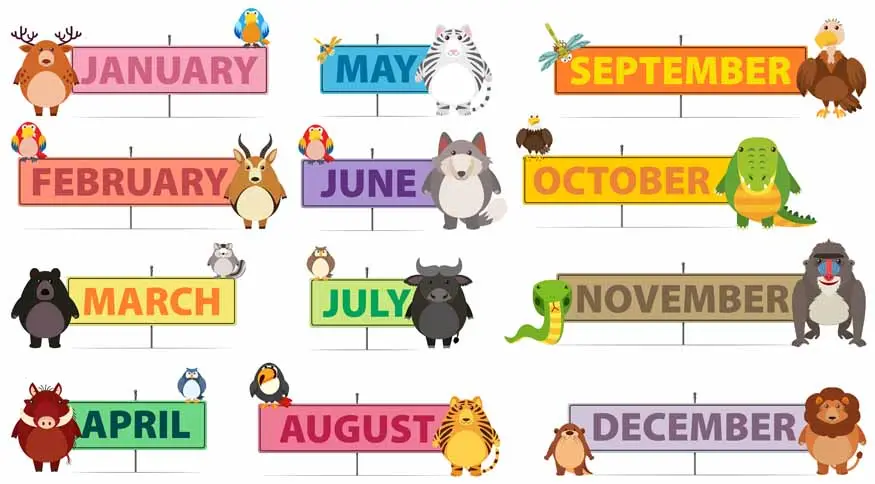
There are 12 months in a year. The months follow the same order every year, starting with January and ending with December. These twelve month names come from the ancient Roman calendar and are used worldwide as part of the Gregorian calendar system. Along with the days of the week in English, months are one of the most essential time-related vocabulary words for English learners. Whether you are a student learning English, a parent teaching your child, or simply looking for interesting facts, this guide covers everything you need to know about the months of the year in English including their correct spelling, abbreviations, pronunciation, origins, the number of days in each month, and creative ways to help children memorise them.
List of All 12 Months of the Year in English
The table below shows all 12 months of the year in their correct order, along with their abbreviations (short forms), the number of days, the season they belong to in the Northern Hemisphere, and a simple pronunciation guide.
| Order | Month | Short Form | Days | Season | Pronunciation |
| 1 | January | Jan | 31 | Winter | JAN-yoo-air-ee |
| 2 | February | Feb | 28/29 | Winter | FEB-roo-air-ee |
| 3 | March | Mar | 31 | Spring | MAHRCH |
| 4 | April | Apr | 30 | Spring | AY-pril |
| 5 | May | May | 31 | Spring | MAY |
| 6 | June | Jun | 30 | Summer | JOON |
| 7 | July | Jul | 31 | Summer | joo-LY |
| 8 | August | Aug | 31 | Summer | AW-gust |
| 9 | September | Sep | 30 | Autumn | sep-TEM-ber |
| 10 | October | Oct | 31 | Autumn | ok-TOH-ber |
| 11 | November | Nov | 30 | Autumn | no-VEM-ber |
| 12 | December | Dec | 31 | Winter | dee-SEM-ber |
Note: February has 28 days in a regular year and 29 days in a leap year. A leap year occurs every four years (e.g., 2024, 2028, 2032). Month names are always capitalised in English because they are proper nouns.
How Many Days Are in Each Month?
Not all months are the same length. Seven months have 31 days, four months have 30 days, and February has either 28 or 29 days. The table below makes this easy to see at a glance.
| Months with 31 Days | Months with 30 Days | Month with 28/29 Days |
| January, March, May, July, August, October, December | April, June, September, November | February (28 days; 29 in a leap year) |
A well-known English rhyme helps you remember which months have 30 days:
“Thirty days hath September, April, June, and November. All the rest have thirty-one, except February alone, which has twenty-eight days clear, and twenty-nine in each leap year.”
Months of the Year by Season
Grouping the months by season is a helpful way to learn them. The seasons listed below apply to the Northern Hemisphere. In the Southern Hemisphere, the seasons are reversed — for example, June, July, and August are winter months in Australia and South Africa.
| Season | Months (Northern Hemisphere) |
| Winter | December, January, February |
| Spring | March, April, May |
| Summer | June, July, August |
| Autumn (Fall) | September, October, November |
Facts About Each Month of the Year
Every month has its own history, unique characteristics, and interesting facts. Most English month names have roots in Latin and Roman culture — some are named after gods, some after Roman leaders, and others after Latin numbers. Below is a closer look at each of the 12 months.
1. January – The First Month of the Year
Origin: Named after Janus, the Roman god of beginnings, transitions, and doorways. Janus was often depicted with two faces — one looking to the past and one to the future.
January has 31 days and marks the start of a new year. New Year’s Day on January 1st is celebrated in nearly every culture worldwide. In the Northern Hemisphere, January is typically the coldest month, while in the Southern Hemisphere it falls in the middle of summer. The birthstone for January is garnet, and the birth flower is the carnation.
Fun fact: January was not always the first month. In the original Roman calendar, the year began in March. January was moved to the front of the calendar around 713 BC.
2. February – The Shortest Month
Origin: Named after Februa, an ancient Roman festival of purification and cleansing held in mid-February.
February is the second month and the shortest month of the year, with only 28 days in a common year and 29 days in a leap year. Valentine’s Day on February 14th is the most widely recognised holiday of this month. The birthstone is amethyst, and the birth flower is the violet.
Fun fact: February is the only month that can pass without a single full moon. This rare event is sometimes called a “Black Moon month.”
3. March – The Month of New Beginnings
Origin: Named after Mars, the Roman god of war, who was also considered a guardian of agriculture.
March has 31 days and marks the beginning of spring in the Northern Hemisphere with the spring equinox occurring around March 20th. St. Patrick’s Day on March 17th is widely celebrated. The birthstone is aquamarine, and the birth flower is the daffodil.
Fun fact: March was the first month of the year in the original Roman calendar. This is why September through December have names based on the Latin numbers seven through ten — they were originally the 7th to 10th months.
March is a great time to introduce children to the natural world. As migratory birds return in spring, you can use our guide on bird names in English for kids to make outdoor learning exciting.
4. April – The Month of Growth
Origin: Likely from the Latin word “aperire,” meaning “to open,” referring to flowers and buds opening in spring.
April has 30 days and is known for spring showers. April Fools’ Day on April 1st is celebrated with jokes and pranks. Earth Day is observed on April 22nd. The birthstone is diamond, and the birth flower is the daisy.
Fun fact: April is one of only four months with exactly 30 days. The others are June, September, and November.
5. May – The Month of Flowers
Origin: Named after Maia, the Greek goddess of fertility and growth, who was associated with springtime.
May has 31 days and is often considered one of the most pleasant weather months. Mother’s Day is celebrated on the second Sunday of May in many countries. The birthstone is emerald, and the birth flower is the lily of the valley. May is also the only month whose abbreviation is the same as its full name.
Fun fact: No other month in any given year starts on the same day of the week as May, making it unique on the calendar.
May is a wonderful time to teach children about nature. Explore our guide on flower names in English for kids to make springtime learning even more fun.
6. June – The Month of Sunshine
Origin: Named after Juno, the Roman goddess of marriage and childbirth, and wife of Jupiter, king of the gods.
June has 30 days. The summer solstice, the longest day of the year, occurs around June 21st in the Northern Hemisphere. June is one of the most popular months for weddings, perhaps because it is named after the goddess of marriage. Father’s Day is celebrated on the third Sunday of June. The birthstone is pearl or alexandrite, and the birth flower is the rose.
Fun fact: In the Southern Hemisphere, June is actually the start of winter and one of the coldest months.
7. July – The Height of Summer
Origin: Named after Julius Caesar, the Roman general and dictator. It was originally called Quintilis, meaning “fifth month.”
July has 31 days and is the warmest month in many parts of the Northern Hemisphere. Independence Day is celebrated in the United States on July 4th. The birthstone is ruby, and the birth flower is the water lily.
Fun fact: July is the first month in the calendar named after a real historical person rather than a god or goddess. It was renamed in 44 BC to honour Julius Caesar, who was born on July 12th.
8. August – The Last Full Month of Summer
Origin: Named after Augustus Caesar, the first Roman emperor. It was originally called Sextilis, meaning “sixth month.”
August has 31 days and is the last full month of summer in the Northern Hemisphere. It is a popular time for holidays and travel. The birthstone is peridot, and the birth flower is the gladiolus.
Fun fact: August originally had only 30 days, but a 31st day was added so that Augustus Caesar’s month would not be shorter than Julius Caesar’s month of July.
9. September – The Start of Autumn
Origin: From the Latin “septem,” meaning seven, because it was the seventh month in the original Roman calendar.
September has 30 days. The autumn equinox occurs around September 22nd, marking the start of fall in the Northern Hemisphere. Many schools begin their academic year in September. The birthstone is sapphire, and the birth flower is the aster.
Fun fact: Despite its name meaning “seventh,” September has been the ninth month for over 2,000 years, ever since January and February were added to the Roman calendar.
10. October – The Month of Harvest
Origin: From the Latin “octo,” meaning eight, as it was the eighth month in the original Roman calendar.
October has 31 days and is known for autumn foliage, harvest festivals, and Halloween on October 31st. In much of the Northern Hemisphere, the leaves change colour during October. The birthstone is opal or tourmaline, and the birth flower is the marigold.
Fun fact: Halloween originated from the ancient Celtic festival of Samhain, a celebration marking the end of the harvest season and the beginning of winter.
11. November – The Month of Gratitude
Origin: From the Latin “novem,” meaning nine, as it was the ninth month in the original Roman calendar.
November has 30 days. Thanksgiving is celebrated on the fourth Thursday of November in the United States. Temperatures drop significantly in the Northern Hemisphere. The birthstone is topaz or citrine, and the birth flower is the chrysanthemum.
Fun fact: November 11th is observed as Veterans Day in the United States and Remembrance Day in the United Kingdom, Canada, and Australia, honouring military veterans and those who died in service.
12. December – The Final Month of the Year
Origin: From the Latin “decem,” meaning ten, as it was the tenth month in the original Roman calendar.
December has 31 days and is the most festive month, with Christmas on December 25th, Hanukkah, Kwanzaa, and New Year’s Eve on December 31st. The winter solstice, the shortest day of the year, occurs around December 21st. The birthstone is tanzanite or turquoise, and the birth flower is the narcissus.
Fun fact: Despite its name meaning “tenth,” December has been the twelfth and final month of the year for over 2,000 years.
Month Abbreviations (Short Forms)
In daily life, we often use short forms of month names on calendars, forms, tickets, and informal writing. The most common abbreviations use the first three letters of each month: Jan, Feb, Mar, Apr, May, Jun, Jul, Aug, Sep, Oct, Nov, Dec. In American English, a period is usually added after the abbreviation (e.g., Jan.), while in British English the period is often omitted (e.g., Jan). May is the only month that does not need an abbreviation because its name is already short.
Also Read:
Simple General Knowledge Questions & Answers for Kids
How to Pronounce the Months in English
Pronouncing month names correctly is important for clear communication. Here are some tips for the months that learners find tricky:
- February: Many people skip the first “r” and say “FEB-yoo-air-ee.” The correct pronunciation includes the “r”: FEB-roo-air-ee.
- June vs. July: June has a long “oo” sound (JOON), while July stresses the second syllable (joo-LY). They sound similar but the stress pattern is different.
- September: The “pt” combination in the middle requires a quick transition from the “p” sound (lips) to the “t” sound (tongue): sep-TEM-ber.
- May vs. March: May uses a long “a” sound (MAY), while March uses a broader “ah” sound followed by the “ch” (MAHRCH).
Common Spelling Mistakes in Month Names
Some month names are frequently misspelled, especially by children and English learners. Here are the most common mistakes and easy ways to avoid them.
| Correct Spelling | Common Mistake | Tip to Remember |
| February | Febuary | Don’t forget the first “r” — say Feb-ru-a-ry slowly. |
| Wednesday | Wendsday | Think: Wed-nes-day (three syllables when spelling). |
| August | Agust | Remember the “Au” at the start, like the word “autumn.” |
| November | Novemeber | Only one “m” and one “b” — No-vem-ber. |
| December | Decemeber | Same pattern as November — De-cem-ber. |
| January | Janurary | No extra “r” — Jan-u-a-ry. |
How to Write Dates Using Month Names
Different countries write dates in different formats. This small difference can change the meaning entirely. For example, 07/04/2025 means July 4th in the US but April 7th in the UK. The table below shows the three most common date formats.
| Format | Style | Example |
| American English | Month/Day/Year | July 4, 2025 or 07/04/2025 |
| British English | Day/Month/Year | 4 July 2025 or 04/07/2025 |
| International (ISO) | Year-Month-Day | 2025-07-04 |
Examples in sentences:
- American English: My birthday is on March 15, 1995.
- British English: My birthday is on 15 March 1995.
- When talking about a month in general, use the preposition “in”: “I was born in March.”
- When talking about a specific date, use “on”: “The meeting is on January 5th.”
The Knuckle Method – An Easy Trick to Remember Days in Each Month
The knuckle method is a simple physical trick that anyone can use to remember how many days are in each month. Here is how it works:
- Make a fist with both hands and hold them side by side, knuckles facing up.
- Starting from the left pinky knuckle, count each knuckle and each valley (dip) between knuckles as a month, going from left to right.
- Knuckle = 31 days. Valley = 30 days (or fewer for February).
- The sequence is: January (knuckle, 31) → February (valley, 28/29) → March (knuckle, 31) → April (valley, 30) → May (knuckle, 31) → June (valley, 30) → July (knuckle, 31) → August (knuckle, 31) → September (valley, 30) → October (knuckle, 31) → November (valley, 30) → December (knuckle, 31).
Notice that July and August are both knuckles (both have 31 days). This is because when you reach the last knuckle on your left hand (July), you start again on the first knuckle of your right hand (August).
How to Teach Kids the Months of the Year
Teaching children the names and order of the 12 months can be easy and enjoyable when you use the right methods. Below are proven strategies that work well for kids of different ages.
1. Sing the Months of the Year Song
One of the simplest and most effective methods is singing the months to a familiar tune. The most popular version is sung to the tune of “Ten Little Indians.” Singing helps children remember the order through rhythm and repetition. Sing it every morning as part of a daily routine and children will memorise the sequence within a few weeks.
2. Use a Calendar Every Day
Hang a large, colourful calendar at your child’s eye level. Every morning, point to the current month and say its name together. Ask your child what month it is, what month comes next, and what month just passed. This daily practice builds familiarity naturally and connects the abstract concept of months to real, everyday life.
3. Connect Months to Birthdays and Holidays
Children learn best when information is personally meaningful. Help your child learn which month their birthday falls in, along with the birthdays of family members and friends. Connect each month to a favourite holiday or event — for example, “December is Christmas month” or “October is Halloween month.” This gives every month a personal anchor in the child’s memory.
4. Create a Months of the Year Craft Project
Have your child create a poster or booklet with one page for each month. On each page, write the month name in large letters and draw or paste pictures that represent that month — snowflakes for January, hearts for February, flowers for May, a sun for July, and so on. The act of creating the visuals reinforces the association between month names and their characteristics.
You can also include seasonal animals in your craft project. Our guide on animal names in English for kids has plenty of ideas to make each month’s page come alive with wildlife illustrations.
5. Play Interactive Card Games
Write each month on a separate card, shuffle them, and ask your child to arrange them in the correct order. You can also play “What comes next?” by saying a month name and asking what month follows. Another option is a “Month Bingo” game where you call out facts about a month and the child identifies which one you are describing.
6. Play Hopscotch with Month Names
A fun twist on the classic hopscotch game: write the month names in the boxes instead of numbers. Let your child hop through the months in order while saying each name out loud. This combines physical movement with learning, which helps younger children retain information more effectively.
7. Build Month Towers with Blocks
Ask your child to build towers using building blocks, with the number of blocks matching the month’s position in the year. January gets one block, February gets two, and so on up to December with twelve blocks. This hands-on activity helps children connect month names to their numerical order.
8. Use Flashcards with Pictures
Make flashcards with the month name on one side and an image representing that month on the other — such as a Christmas tree for December, fireworks for January, or falling leaves for October. Flashcards work well for quick daily review sessions and can be used for matching games.
9. Practise Spelling and Writing
For children who are learning to write, practising the spelling of month names is an excellent reinforcement activity. Provide tracing worksheets for younger children and spelling exercises for older ones. Ask them to write the current month at the top of their homework or drawings every day. Pay special attention to tricky spellings like February, August, and November.
10. Read Books About the Months
There are many wonderful children’s books built around the months of the year. Reading stories that feature each month with its weather, activities, and holidays reinforces learning through storytelling. Visit your local library and ask for recommendations suited to your child’s age group.
Frequently Asked Questions (FAQs)
Q1. How many months are there in a year?
There are 12 months in a year. They are January, February, March, April, May, June, July, August, September, October, November, and December. This structure is based on the Gregorian calendar, the most widely used calendar system in the world.
Q2. What is the order of the 12 months of the year in English?
The 12 months in order are: January (1st), February (2nd), March (3rd), April (4th), May (5th), June (6th), July (7th), August (8th), September (9th), October (10th), November (11th), and December (12th).
Q3. Which month has the fewest days?
February is the shortest month. It has 28 days in a common year and 29 days in a leap year. Leap years occur every four years to account for the extra time it takes the Earth to orbit the Sun.
Q4. Which months have 31 days?
Seven months have 31 days: January, March, May, July, August, October, and December. The remaining four months — April, June, September, and November — have 30 days, while February has 28 or 29 days.
Q5. Which months have 30 days?
Four months have exactly 30 days: April, June, September, and November. The rhyme “Thirty days hath September, April, June, and November” is a popular way to remember them.
Q6. Why are the months named the way they are?
Most month names come from ancient Roman culture. January is named after the god Janus, March after Mars, and May after Maia. July and August honour Julius Caesar and Augustus Caesar. September through December retain Latin number names (seven through ten) from when the year started in March.
Q7. What is a leap year and how does it affect February?
A leap year has 366 days instead of the usual 365. The extra day is added to February, giving it 29 days. Leap years happen every four years, with exceptions for century years not divisible by 400. For example, 2024 and 2028 are leap years, but 1900 was not.
Q8. At what age should children learn the months of the year?
Children can begin learning month names as early as age 3 or 4 through songs and repetition. By age 5 to 6, most children can recite all 12 months in order. By age 7 or 8, they typically understand the relationship between months, seasons, and the number of days in each month.
Q9. What is the easiest way to teach kids the months of the year?
The most effective approach combines singing a months-of-the-year song with daily calendar practice. Songs help children memorise the sequence through rhythm, while daily calendar use reinforces learning visually. Connecting months to birthdays and holidays makes them personally meaningful and easier to remember.
Q10. How many total days are there in a year?
A regular year has 365 days spread across 12 months. A leap year has 366 days because February gets an extra day. The total of all months (31+28+31+30+31+30+31+31+30+31+30+31) equals 365.
Q11. Are month names always capitalised in English?
Yes, month names are always written with a capital letter in English because they are proper nouns. This applies to both the full name and abbreviated forms. For example, “January” and “Jan” are correct; “january” and “jan” are incorrect.
Q12. What prepositions are used with months in English?
Use “in” when talking about a month in general: “I was born in March.” Use “on” when referring to a specific date within a month: “The exam is on March 15th.” These preposition rules are consistent across both American and British English.