Children are fascinated by vehicles from a very early age. Whether it is a bus rumbling down the road, a train chugging along the tracks, or an aeroplane soaring across the sky, vehicles spark curiosity and excitement in young minds. Learning the names of different transport vehicles in English helps children build vocabulary, understand how people and goods move from one place to another, and develop awareness of the world around them.
This guide covers a wide range of transport vehicle names in English, organised by type, to make learning simple and engaging for kids.
Why Should Kids Learn Transport Vehicle Names?
Understanding transport vehicle names benefits children in several important ways. It strengthens their English vocabulary and pronunciation, introduces them to concepts of travel, distance, and geography, and helps them make sense of the vehicles they encounter in daily life. Transport is also a common topic in school lessons, stories, and general knowledge quizzes, so familiarity with vehicle names supports academic learning.
For younger children, identifying and naming vehicles during car rides, walks, or trips is a fun and natural way to practise English in real-world settings.
Road Vehicles
Road vehicles are the ones children see most frequently in their everyday lives. They travel on roads, streets, and highways.
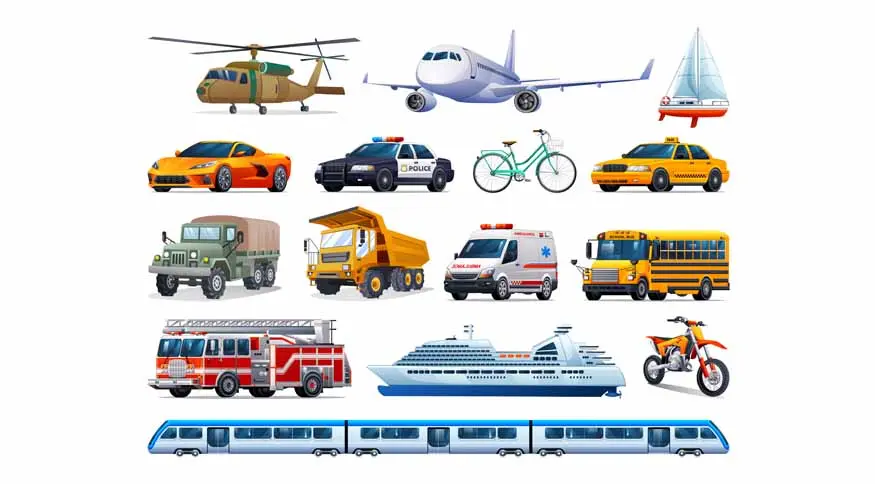
Car – The most common passenger vehicle, cars come in many sizes and shapes. Families use cars for daily commutes, school runs, and road trips. Popular types include sedans, hatchbacks, and SUVs.
Bus – A large vehicle designed to carry many passengers at once. City buses, school buses, and long-distance coaches are all types of buses. In India, state transport buses connect towns and cities across the country.
Auto Rickshaw – A three-wheeled vehicle widely used in Indian cities and towns for short-distance travel. Auto rickshaws are compact, affordable, and easy to spot with their open sides and colourful bodies.
Bicycle – A two-wheeled vehicle powered by pedalling. Bicycles are eco-friendly, require no fuel, and are often the first vehicle children learn to ride on their own.
Motorcycle – A two-wheeled motorised vehicle faster than a bicycle. Motorcycles and scooters are among the most popular modes of personal transport in India.
Truck – A heavy vehicle used to transport goods over long distances. Trucks carry everything from food and fuel to building materials and furniture. Large trucks on Indian highways are often decorated with colourful paintings and slogans.
Ambulance – A specially equipped vehicle used to transport sick or injured people to hospitals. Ambulances carry medical equipment and are fitted with sirens and flashing lights to move quickly through traffic.
Fire Engine – A large red vehicle equipped with water tanks, hoses, ladders, and rescue tools. Fire engines rush to the scene of fires and other emergencies to save lives and property.
Police Car – A vehicle used by the police to patrol streets, respond to emergencies, and maintain law and order. Police cars are usually marked with distinctive colours and fitted with sirens.
Taxi – A car available for hire to take passengers to their desired destination. In India, taxis range from traditional yellow-and-black cabs in Mumbai to app-based ride services in major cities.
Tractor – A powerful vehicle used mainly on farms to plough fields, pull heavy loads, and carry agricultural produce. Tractors are a familiar sight in rural India.
Bullock Cart – A traditional vehicle pulled by oxen, used for centuries in Indian villages to transport people and goods. While less common today, bullock carts are still seen in many rural areas.
Rickshaw – A human-pulled or cycle-powered vehicle used for short trips, especially in older parts of Indian cities like Kolkata and Varanasi.
Water Vehicles
Water vehicles, also called watercraft or vessels, travel on rivers, lakes, seas, and oceans. Learning about them introduces children to a different mode of transport altogether.
Boat – A small watercraft used for fishing, short trips across rivers, or leisure rides. Boats can be powered by oars, sails, or motors. In Kerala, traditional wooden boats called “vallam” are part of daily life.
Ship – A large vessel built to carry passengers or cargo across oceans and seas. Cargo ships transport goods between countries, while cruise ships carry tourists on holiday voyages.
Ferry – A boat or ship that carries passengers, vehicles, and goods across a body of water on a regular route. Ferries operate across rivers, lakes, and coastal waters in many parts of India.
Submarine – An underwater vessel used mainly by the navy for defence and exploration. Submarines can travel deep beneath the ocean surface and stay submerged for extended periods.
Yacht – A medium-sized watercraft used for recreation, racing, or luxury travel. Yachts are powered by sails or engines and are often associated with leisure and sport.
Canoe – A narrow, lightweight boat typically paddled by one or two people using single-bladed paddles. Canoes are popular for river exploration and water sports.
Houseboat – A boat designed for living aboard, with rooms, kitchens, and other amenities. The houseboats of Kashmir and Kerala are famous tourist attractions in India.
Sailboat – A boat propelled by sails that catch the wind. Sailboats range from small recreational vessels to large racing boats.
Speedboat – A fast motorised boat used for water sports, rescue operations, and quick transportation across water.
Kayak – A small, narrow watercraft in which the paddler sits facing forward and uses a double-bladed paddle. Kayaking is a popular adventure sport in rivers and lakes.
Air Vehicles
Air vehicles fly through the sky and are some of the most exciting modes of transport for children to learn about.
Aeroplane – A large flying vehicle with wings and engines that carries passengers and cargo across countries and continents. Aeroplanes are the fastest way to travel long distances.
Helicopter – An aircraft that uses rotating blades on top to fly, hover, and land in tight spaces. Helicopters are used for rescue missions, medical emergencies, military operations, and short-distance travel.
Hot Air Balloon – A large balloon filled with heated air that rises into the sky, carrying a basket with passengers below. Hot air balloon rides are popular tourist experiences in places like Rajasthan and Goa.
Glider – A lightweight aircraft without an engine that soars through the air using wind currents. Gliders are used for recreation and sport flying.
Drone – An unmanned aircraft controlled remotely or programmed to fly on its own. Drones are used for photography, delivery, farming, surveillance, and many other purposes.
Jet – A high-speed aircraft powered by jet engines. Fighter jets are used by the air force, while private jets serve as luxury transport.
Seaplane – An aeroplane designed to take off from and land on water. Seaplane services have been introduced in a few locations in India for scenic and short-distance travel.
Rocket – A vehicle that travels beyond the Earth’s atmosphere into space. Rockets carry satellites, spacecraft, and astronauts. India’s ISRO has launched numerous successful rocket missions.
Rail Vehicles
Rail vehicles run on tracks and are one of the most important modes of public transport in India and around the world.
Train – A long vehicle made up of connected coaches that runs on railway tracks. Indian Railways operates one of the largest rail networks in the world, connecting thousands of cities, towns, and villages.
Metro – An urban rail system that runs underground or on elevated tracks within a city. Metro services operate in Delhi, Mumbai, Bangalore, Chennai, Kolkata, Hyderabad, and several other Indian cities.
Tram – A rail vehicle that runs on tracks laid along city streets. Kolkata is the only city in India that still operates a tram network, preserving a mode of transport that dates back to the 1800s.
Monorail – A rail system where the train runs on a single rail instead of two. Mumbai operates a monorail line that serves parts of the city.
Bullet Train – A high-speed train capable of travelling at speeds exceeding 300 kilometres per hour. India’s first bullet train project, connecting Mumbai and Ahmedabad, is currently under development.
Freight Train – A train used to transport goods and raw materials rather than passengers. Freight trains carry coal, grains, petroleum, and manufactured products across the country.
Cable Car – A small cabin suspended from a cable that moves between two stations, usually in hilly or mountainous areas. Cable cars in Shimla, Mussoorie, and Darjeeling offer scenic rides to tourists.
Emergency and Service Vehicles
These vehicles perform essential services and are important for children to recognise.
Ambulance – Transports patients to hospitals and carries life-saving medical equipment.
Fire Engine – Responds to fires and rescue emergencies with water tanks, hoses, and ladders.
Police Car – Used by law enforcement for patrols, emergencies, and maintaining public safety.
Garbage Truck – Collects waste from homes and streets and transports it to disposal or recycling facilities.
Tow Truck – Pulls or carries broken-down or illegally parked vehicles to repair shops or impound lots.
Road Roller – A heavy vehicle with large cylindrical rollers used to flatten and compact road surfaces during construction.
Crane Truck – A truck equipped with a crane for lifting and moving heavy objects at construction sites, ports, and accident scenes.
Transport Vehicles and Their Uses
Grouping vehicles by their purpose helps children understand why different types of transport exist.
Passenger transport – Car, Bus, Auto Rickshaw, Train, Metro, Aeroplane, Ferry, and Taxi carry people from one place to another.
Goods transport – Truck, Freight Train, Cargo Ship, and Delivery Van move products, raw materials, and supplies.
Emergency services – Ambulance, Fire Engine, Police Car, and Rescue Helicopter respond to urgent situations.
Agricultural vehicles – Tractor, Harvester, and Bullock Cart are used in farming and rural transport.
Recreational vehicles – Yacht, Hot Air Balloon, Kayak, and Cable Car are associated with leisure, sport, and tourism.
Construction vehicles – Road Roller, Crane Truck, Bulldozer, and Excavator are used to build roads, buildings, and infrastructure.
Fun Facts About Transport Vehicles for Kids
Sharing fun facts makes vehicle learning exciting and memorable for children.
The first car ever built was the Benz Patent-Motorwagen, created by Karl Benz in 1886. It had only three wheels and could reach a top speed of about 16 kilometres per hour.
The Indian Railways network stretches over 68,000 kilometres of track, making it one of the longest rail networks in the world. More than 20 million passengers travel by Indian trains every single day.
The largest ship ever built was the Seawise Giant, a supertanker that measured 458 metres in length, longer than the height of the Empire State Building laid on its side.
The Airbus A380 is the largest passenger aeroplane in the world and can carry over 500 passengers on two full decks. A helicopter can fly forward, backward, sideways, and even hover in one spot, something no aeroplane can do.
The fastest train in the world is the Shanghai Maglev in China, which reaches speeds of 431 kilometres per hour using magnetic levitation technology. Bicycles are the most energy-efficient form of transport ever invented, requiring less energy per kilometre than any other vehicle, including walking.
The London Underground, opened in 1863, was the world’s first underground railway system. Mumbai’s dabbawalas use a combination of bicycles, trains, and handcarts to deliver over 200,000 lunchboxes every day with an error rate of nearly zero.
Activities to Help Kids Learn Vehicle Names
Parents and teachers can turn vehicle learning into a fun, hands-on experience. A “vehicle spotting” game during car rides or walks where children name every vehicle they see is an easy and entertaining starting point. Drawing and colouring different vehicles while labelling their names in English builds both vocabulary and creativity.
Creating a transport scrapbook with pictures sorted by category (road, water, air, rail) helps children organise their knowledge visually. Playing with toy vehicles while naming each one and discussing what it does reinforces learning through play. Watching short videos or reading picture books about how vehicles work adds depth and context to names children are learning.
Building simple models of vehicles using cardboard, paper, or craft materials combines vocabulary learning with hands-on creativity. Flashcard games with a vehicle picture on one side and its name and one fun fact on the other are effective revision tools for younger learners.
How to Teach Vehicle Names to Young Learners
Start with five to ten vehicles children already see regularly, such as car, bus, bicycle, auto rickshaw, and train. Use real sightings, toy vehicles, photographs, or short videos rather than relying only on text. Encourage children to describe the vehicle first, noting its size, colour, number of wheels, and where it travels, before introducing its name.
Build associations by connecting vehicle names to everyday experiences (bus and school, ambulance and hospital), sounds (train whistle, helicopter blades), places (metro and city, tractor and farm), or occupations (pilot and aeroplane, captain and ship). Revisit vehicle names through casual conversations during travel, outdoor play, or bedtime reading.
For older children, introduce topics like road safety, pollution and eco-friendly transport, the history of vehicles, and how different countries use different modes of transport. These conversations deepen understanding and connect vocabulary to broader learning.
Conclusion
Transport vehicles are a part of children’s daily experience, making them a natural and exciting topic for vocabulary building. From the everyday bus and bicycle to the thrilling aeroplane and rocket, every vehicle name a child learns broadens their understanding of how the world moves. Encourage your child to observe, ask questions, and explore the many modes of transport around them. The curiosity they develop today will drive their learning for years to come.
Also Read:
Bird Names in English for Kids
Flower Names in English for Kids